About Psilopogon asiaticus (Latham, 1790)
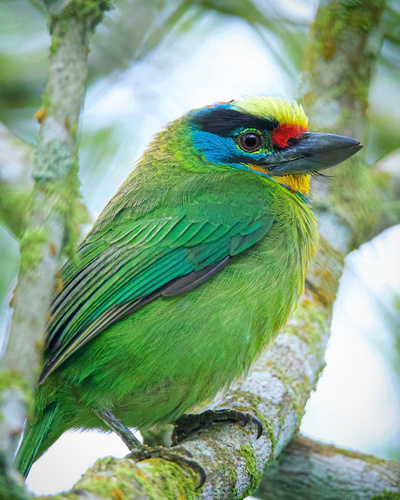
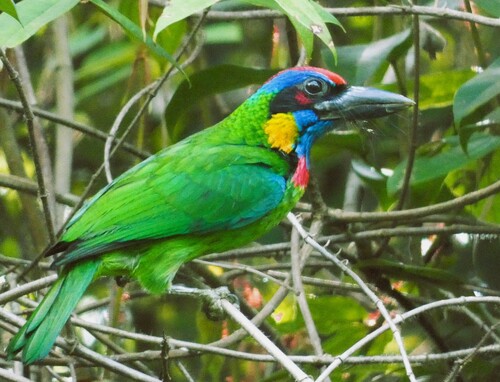
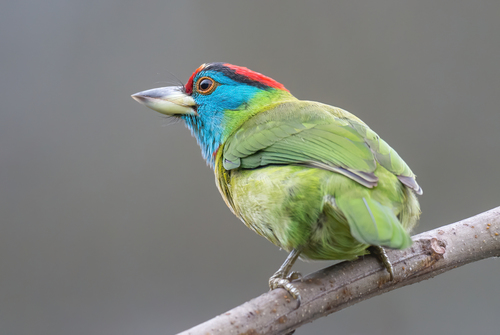
This species, the blue-throated barbet, is a non-migratory, arboreal, medium-sized barbet, roughly the size of a myna, measuring 19–22 cm (7.5–8.7 in) in length. Males and females have similar appearance, but females are slightly heavier, weighing 87–103 g (3.1–3.6 oz) compared to males that weigh 79–100 g (2.8–3.5 oz). It is a stocky, green bird with a short tail. Its undersides are a lighter yellow-green, and the underside of the tail may have a bluish tint. The head and neck have a distinct pattern: a bright red forehead, a black stripe across the crown, and red on the rear crown. The sides of the face, chin, and upper throat are pale blue, with red patches on the sides of the neck at the base of the blue area. The iris is reddish-brown, and the eye-ring can be brown, greenish-brown, orange-brown, or yellow. The feet are slate-gray to gray-green. Its stout, conical bill is pale at the base, with a dark upper mandible and tip. Juveniles resemble adults but have muted, duller colors; their red markings may be tinged with orange, and their black markings may be blue-black or dusky. The blue-throated barbet is a resident breeding species found in the Lower Himalayas, ranging from northeastern Pakistan through northern and northeastern India, as well as in the hill ranges of Southeast Asia. It is a common inhabitant of lowland and foothill tropical, evergreen, and deciduous forests, usually found between 200–2,000 m (660–6,560 ft) in elevation. It can adapt to secondary forests and even urban areas as long as fruiting trees are easily available. In Mizoram, it is uncommon in oil plantations, which is thought to be caused by the lack of fruit-bearing trees there. The blue-throated barbet has a noisy, undulating flight pattern: it completes a few rapid wing beats, then pauses briefly before repeating the sequence. It calls frequently throughout the day. Because its green plumage allows it to blend into the tree canopy, its loud, frequent calls are often the only sign of its presence. Its calls, which consist of the notes took-a-rook, pu-ku-ruk, or kut-ru-uk, are repeated 90 to 105 times per minute.