About Psilocybe yungensis Singer & A.H.Sm.
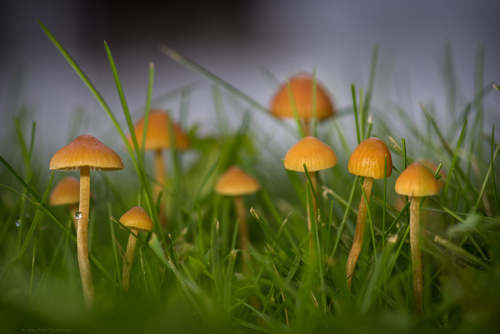
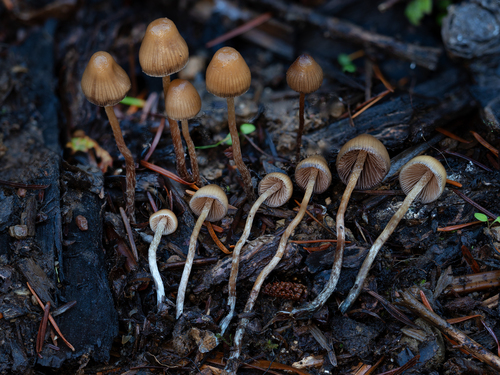
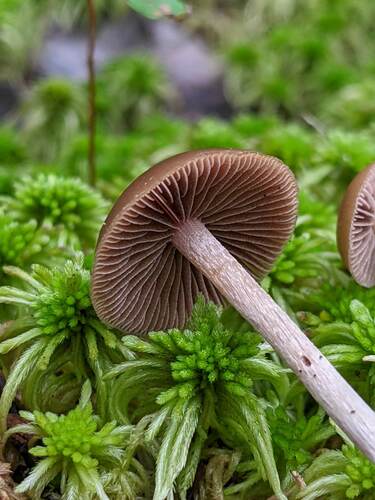
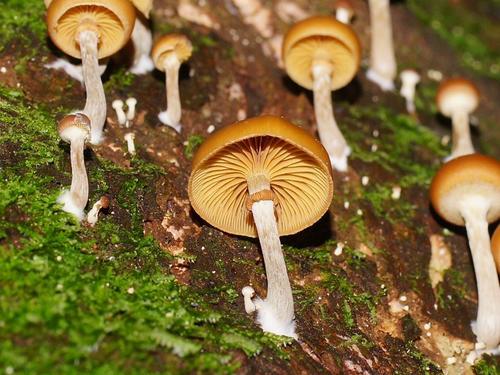
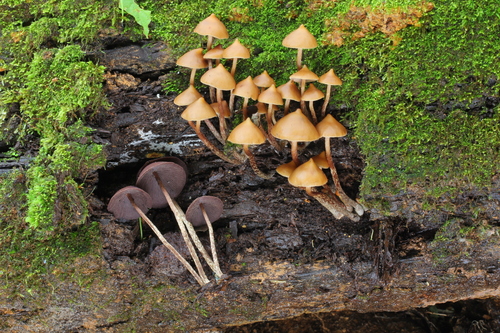
Psilocybe yungensis Singer & A.H.Sm. has fruit bodies with conical to bell-shaped caps at maturity, reaching up to 2.5 cm (1.0 in) in diameter. The cap surface is smooth, sticky, and bears faint radial striations (grooves) that extend almost to the margin in moist specimens. Fresh cap colors range from dark reddish-brown to rusty brown to orangish-brown. The cap is hygrophanous, changing color based on hydration state: dry caps fade to dull yellowish-brown or dingy straw color. A prominent umbo is frequently present on the cap. Gills attach to the stem anywhere between broadly adnate and narrowly adnexed, are narrow and spaced close to crowded. Gills start dull gray, and mature to purplish-brown as spores develop. The stem is 3 to 5 cm (1.2 to 2.0 in) long, 1.5 to 2.5 mm (0.06 to 0.10 in) thick, roughly equal in width along its length or slightly wider near the base. The stem is hollow and brittle, pale brown on its upper section and reddish-brown near the base. It is densely covered with whitish fibrils pressed flat against the surface; these fibrils slough off as the mushroom matures, leaving a smooth surface. The mushroom has a cortinate partial veil, similar to the webby cortina of Cortinarius species, that does not persist long. It occasionally leaves sparse tissue remnants hanging on the cap margin and upper stem, and no ring remains on the stem after the veil disappears. All parts of the mushroom stain blue when injured, and these stains turn black as the mushroom dries. The spore print is dark purplish-brown. Spores range in shape from roughly rhomboid to roughly elliptical, typically 5–6 by 4–6 μm, with thick walls and a large germ pore. Spore-bearing basidia are club-shaped to swollen, hyaline, usually four-spored (rarely two- or three-spored), and measure 13–19 by 4.4–6.6 μm. Pleurocystidia (cystidia on the gill face) are ventricose (swollen) near the base, often mucronate (ending abruptly in a short sharp point) at the apex, measure 14–25 by 4.4–10.5 μm, and are relatively sparse. Cheilocystidia (cystidia on the gill edge) are variable in shape, measure 14–40 by 4.4–7.7 μm, and are abundant. Clamp connections are present in the hyphae. A drop of potassium hydroxide solution turns both the cap and stem from brown to blackish. Psilocybe yungensis is a saprobic species that degrades organic matter in soil and contributes to nutrient cycling in the forests where it grows. It typically grows in clusters or groups on rotting wood, rarely on humus, and is less often found growing solitary. It is commonly reported from coffee plantations, subtropical forests, and cloud forests, especially at elevations between 1,000 and 2,000 m (3,300 and 6,600 ft). The species occurs in northeast, central, and southeastern Mexico, and has been recorded in the Mexican states of Oaxaca, Puebla, Tamaulipas, and Veracruz. It is also known from Bolivia, Colombia, Ecuador, and the Caribbean island of Martinique, and was reported from China in 2009. In Mexico and Colombia, the fungus usually fruits between June and July; in Bolivia, it has been recorded fruiting during January. The fruit bodies of Psilocybe yungensis are used for entheogenic, spiritual, and ritualistic purposes by the Mazatec Indians in the Mexican state of Oaxaca. Some authorities have suggested that P. yungensis is the "tree fungus" reported by 17th and 18th century Jesuit missionaries: a reddish mushroom that was the source of an intoxicating beverage used by the Yurimagua Indians of Amazonian Peru. There is no established record of hallucinogenic mushroom use in that area, however, and the fungus in question could instead be a psychedelic wood-dwelling species of the genus Gymnopilus.