About Psilocybe stuntzii Guzmán & J.Ott
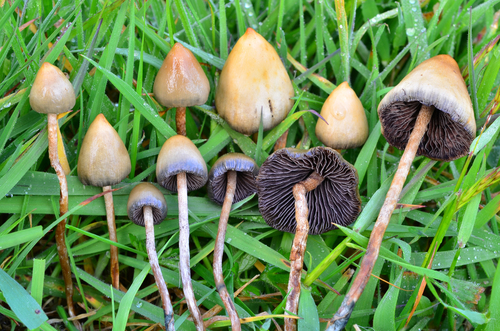
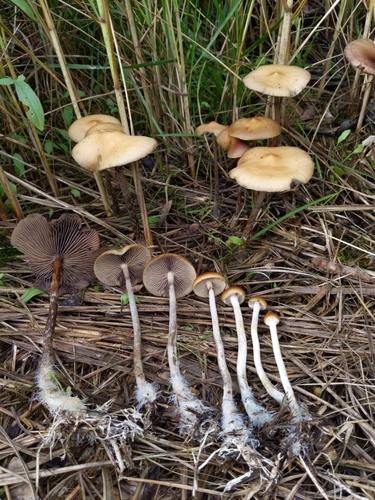
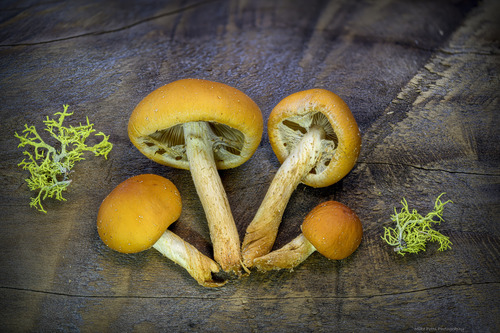
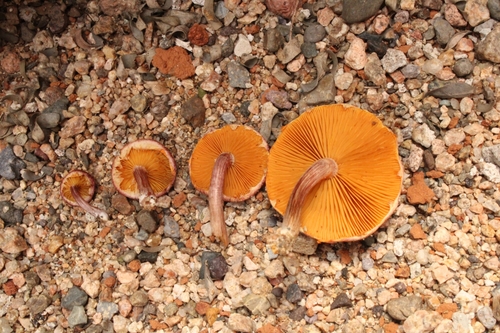
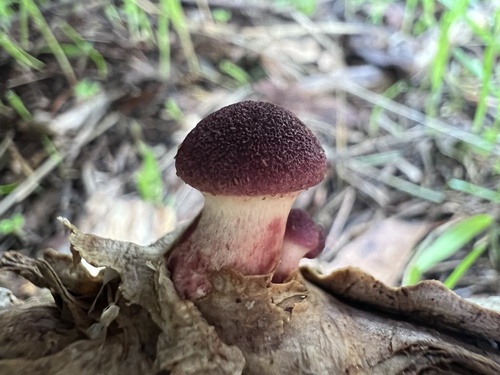
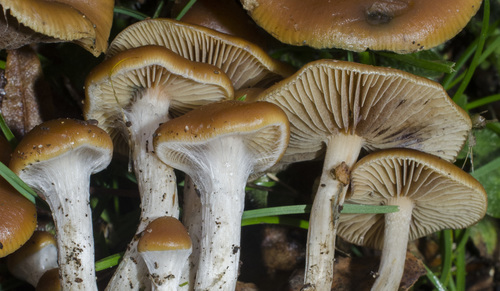
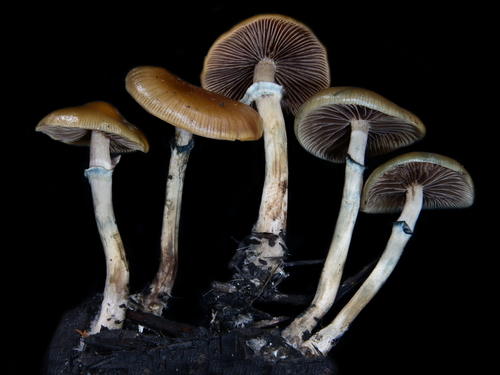
Psilocybe stuntzii Guzmán & J.Ott has a pileus (cap) that ranges from 0.5 to 3.5 centimeters (1⁄4 to 1+1⁄2 inches) across. It starts out obtusely conic to convex, and expands to become convex-umbonate or flat with age. When moist, the cap margin is translucent-striate, and it curves upward as the mushroom ages. The cap is hygrophanous and glabrous; it is dark chestnut brown, with lighter coloration toward the center. It can sometimes be olive-greenish, and fades to pale yellowish brown or pale yellow. When moist, it is viscid due to a gelatinous pellicle, and stains slightly greenish-blue when injured or as it ages. The gills can be adnate, sinuate, or adnexed; they range from close to sub-distant in spacing, are moderately broad. They start yellowish brown, and quickly become violet brown, chocolate brown, or blackish violet. Gills are either uniform or somewhat mottled, and have whitish edges. The spore print of this species is dark violaceous brown. The stipe (stem) measures 2–7.5 cm long by 1.5–6 mm thick. It is equal or slightly enlarged at the base, cylindric or subcylindric, sometimes twisted and striate, and often flexuous. Its surface ranges from glabrous to slightly fibrillose, it is dry, it is stuffed with pith when young and becomes hollow with age. Its color ranges from white or whitish silky to ochraceous or brownish fibrillose. The thin, membranous partial veil leaves a fragile annulus (ring) that becomes more noticeable as it darkens from collecting spores. The mushroom stains blue-green when injured, with the most noticeable staining occurring on the ring. Both the taste and odor of Psilocybe stuntzii are farinaceous. In terms of habitat and distribution, Psilocybe stuntzii grows scattered to gregarious to cespitose, and rarely grows solitary. It grows in conifer wood chips, bark mulch, soils rich in woody debris, new lawns with freshly laid sod, or any newly mulched garden throughout the western Pacific Northwest. It fruits from late July through December, and can be observed year-round in the Seattle area. It has also been reported growing in California, rarely as far south as Santa Cruz. At one point, this species appeared in over 40 percent of all new lawns and mulched areas in the Puget Sound region of the Pacific Northwest. Following the disappearance of pastures south of Seattle, in the Tukwila-Kent-Auburn areas, this mushroom now only appears sporadically in certain well fertilized, manicured new lawns.