About Psilocybe fimetaria (P.D.Orton) Watling
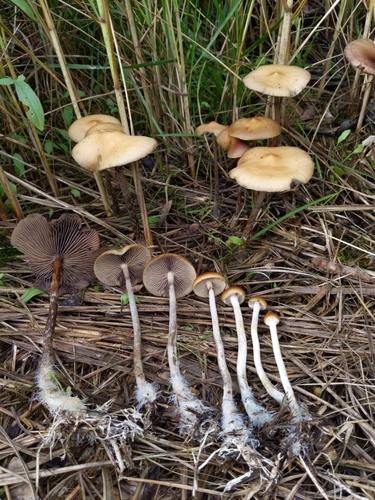
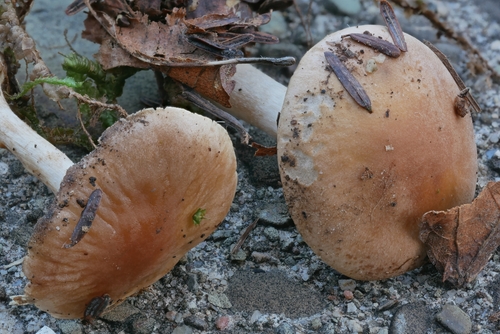
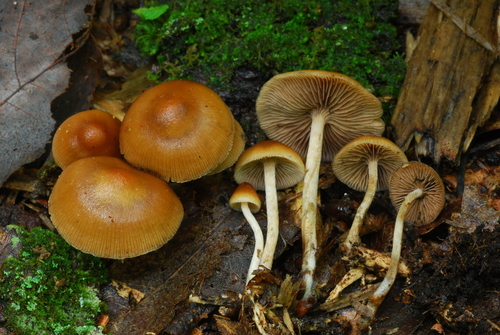
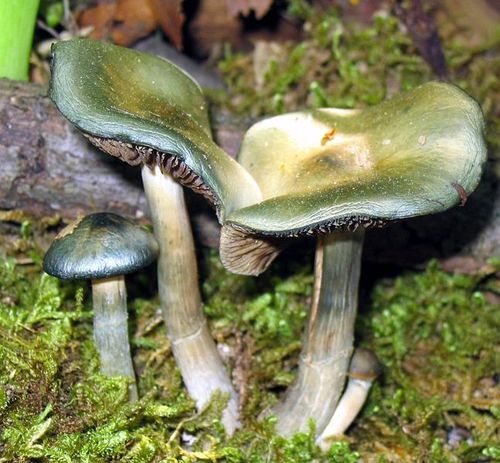
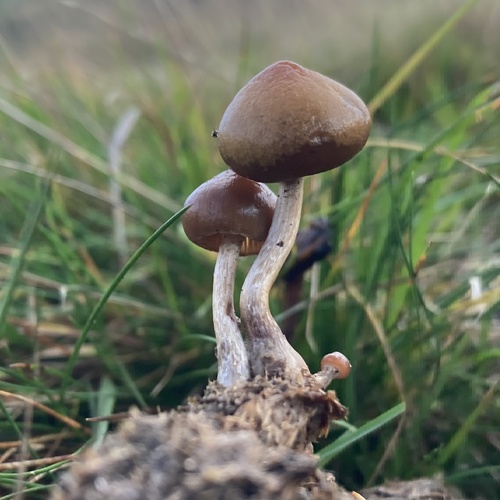
Psilocybe fimetaria (P.D.Orton) Watling has a cap 0.5 to 3.5 cm in diameter. It starts out papillate to convex, and becomes umbonate to broadly convex as it matures. The cap surface is even to translucent-striate near the margin, and is viscid when moist due to a thick, separable gelatinous pellicle. Velar remnants are often present on the cap surface, most typically around the margin. Cap color ranges from pale reddish brown to ochraceous; it is hygrophanous, fading to yellowish olive to ochraceous buff when it dries. The cap flesh is whitish to honey colored.
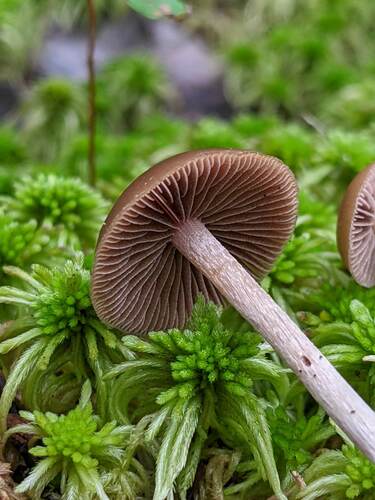
The gills are adnexed, free, or sinuate. They are close together, interleaving, and ventricose. When young, gills are whitish clay colored, and eventually become dark reddish brown with an olivaceous hue, with a white fimbriate edge. The spore print is dark purple-brown. Spores measure (9.5)12.5 — 15(16) × 6.5 — 9.5 μm, are ovoid in front view, ellipsoid in side view, thick-walled, and have a broad germ pore.
The stipe is 2 – 9 cm long and (0.5)2 – 4 mm thick. It is cylindrical, flexuous, and mostly equal, though it sometimes has a slightly swollen base. It is whitish when young, and soon discolors yellow to yellowish brown when handled, becoming reddish brown or honey brown with age; it sometimes develops distinctive blue tones at the base. The stipe surface is covered with whitish fibrils toward the apex, and bears an apical evanescent fibrillose annulus that forms from a thickly cortinate partial veil. Both odor and taste are farinaceous.
Microscopically, basidia are 4-spored. Pleurocystidia are absent. Cheilocystidia measure (15)20 — 30(35) by (4)6 — 8(9) μm, are ventricose-fusiform or lageniform with a narrow neck that is often flexuous, the neck measuring 4 — 15 by 0.5 — 1.5 μm; cheilocystidia are occasionally branched.
This species grows solitary or in small groups on horse or cow dung in grassy areas, fruiting in autumn from September to November. It is generally uncommon and infrequently recorded, but can occasionally grow in large numbers in localized areas. Psilocybe semilanceata may be an indicator species for P. fimetaria, since both favor the same types of grasses, soil, and climatic conditions. Confirmed records of the species exist from Great Britain, Iceland, and much of mainland Europe. Contrary to claims found in much existing literature, there are no confirmed records of P. fimetaria growing in Asia or the Americas, including Canada, the Pacific Northwest, and Chile. Paul Stamets suggests, however, that the actual fruiting range of this mushroom is likely much wider than currently documented.