About Pseudoxiphophorus bimaculatus (Heckel, 1848)
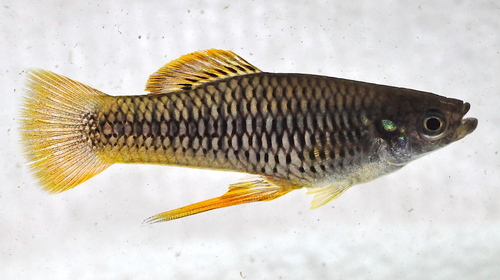
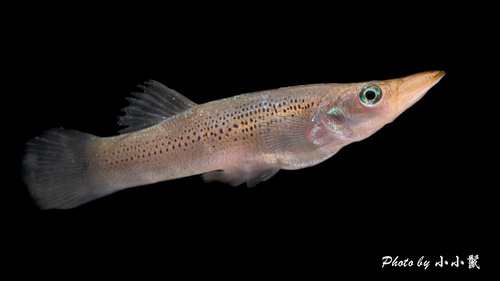
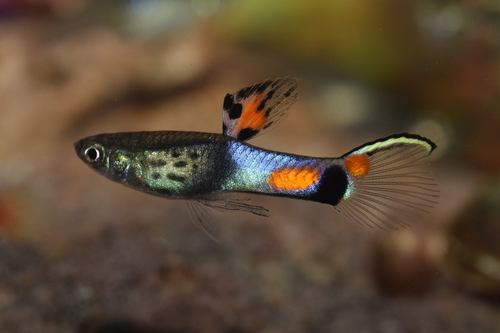
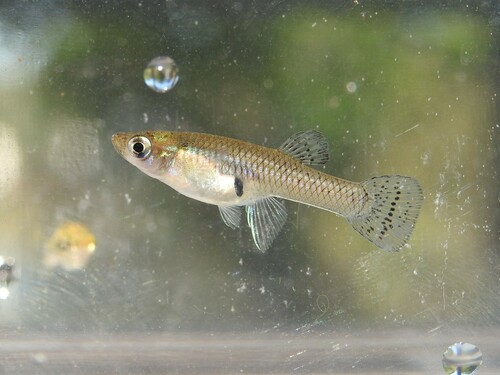
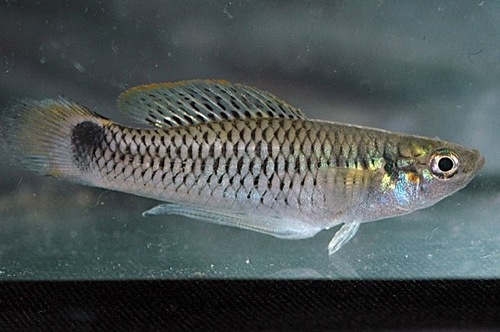
Pseudoxiphophorus bimaculatus is a small freshwater livebearing fish species belonging to the Poeciliidae family. In terms of coloration, individuals of this species often have green iridescence around their operculum, subtle black and yellow tones on their scales and fins, and a distinct black spot on the upper portion of the caudal fin. This black spot is a characteristic feature of the species, and it is present in both males and females. Unlike many other Poeciliidae species, P. bimaculatus has no sword-like extension or protrusion on its caudal fin. The only clear sexual dimorphism between male and female P. bimaculatus is the modified anal fin found in males, called a gonopodium. Males may sometimes have brighter coloration than females, which can make them more vulnerable to predation. Females typically grow larger and heavier than males, with an average standard length of approximately 6.6 cm. Larger female individuals have been recorded, reaching a total length of around 9.1 cm and a maximum weight of 9.96 g. P. bimaculatus is native to Central America and southern Mexico. It is confirmed native to Belize, Guatemala, Nicaragua, and Honduras. In Mexico, its status as native, non-native, or invasive varies by region. The IUCN Red List officially recognizes it as native to the Mexican states of Campeche, Chiapas, Oaxaca, Quintana Roo, Tabasco, Veracruz, and Yucatán. It has been introduced to the Mexican states of Guerrero, Jalisco, and Michoacán, and has also been reported in Guanajuato, Querétaro, and the more northerly state of Tamaulipas. Reproduction in Pseudoxiphophorus bimaculatus is carried out using the male gonopodium. The species does not perform courtship displays; instead, males make quick reproduction attempts, transferring sperm to females via gonopodial thrusts. Spawning occurs year-round, but is most common during the summer months and rainy season. Female P. bimaculatus produce an average of around 31 fertilized eggs. Fertility is linked to environmental conditions including pH, dissolved solid content, and vegetation presence, as well as female size: larger females typically produce more embryos. P. bimaculatus is iteroparous, meaning it can reproduce repeatedly and continuously throughout its lifespan. In populations of this species, females grow larger but reach sexual maturity later than males: females reach sexual maturity at a standard length of around 27 mm, while males reach it at around 22 mm. Population sex ratios are usually female-biased, ranging from 2 females per 1 male to 6 females per 1 male. This skew is often caused by environmental conditions, as males are more vulnerable in areas with higher predation and higher temperatures. Sex ratios are more balanced in habitats where these risks are lower. P. bimaculatus is able to reproduce across a wide range of environmental conditions. Combined with its iteroparous life history and naturally female-biased population ratios, this ability has allowed the species to become established and thrive in ecosystems outside its native range.