About Pseudowintera colorata (Raoul) Dandy
Pseudowintera colorata, commonly known as mountain horopito, is an evergreen shrub or small tree that reaches 1 to 2.5 meters in height. It is often called pepperwood because its leaves have a hot, pungent taste, and it is also known by other common names: New Zealand pepper tree, winter's bark, and red horopito. The name winter's bark comes from early taxonomists who noted its similarity to the South American species Drimys winteri, which provided the herbal remedy also called winter's bark. Both species belong to the family Winteraceae, a plant group that is mostly distributed across landmasses that once formed the ancient southern supercontinent Gondwana: South America, Australia, New Zealand, and New Guinea.
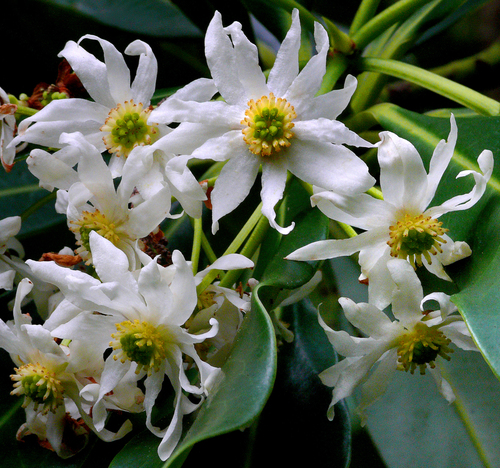
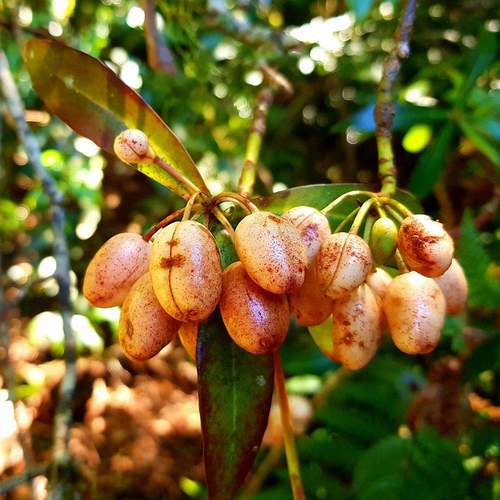
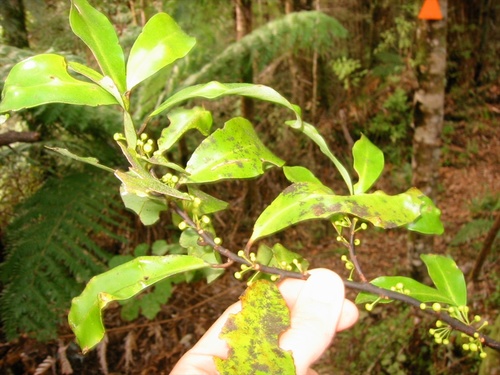
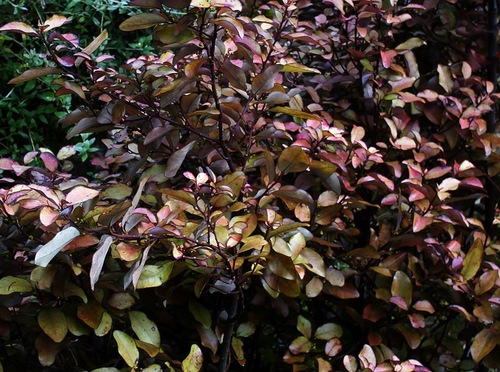
Pseudowintera colorata has yellowish-green leaves marked with red blotches; new leaves that emerge in spring are bright red. Its natural range extends from the Waitakere Ranges in the north, southward from 36° 30' South to Stewart Island / Rakiura, and it grows in habitats from lowland forests up to higher montane forests. A well-documented characteristic plant association for this species occurs in Westland podocarp forests, where it grows alongside associated understory plants including Rumohra adiantiformis, Ascarina lucida, Neopanax colensoi, Raukaua edgerleyi, and Blechnum discolor.
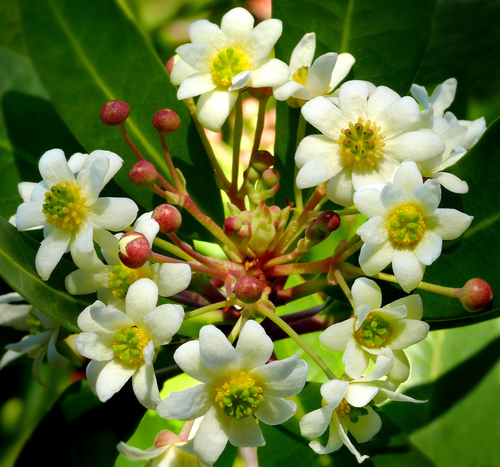
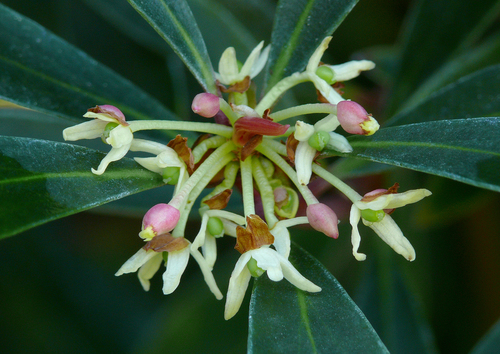
The reproductive structures of Winteraceae are considered primitive, which reflects the family's origin among the earliest groups of flowering plants. Pseudowintera colorata is unusual in that its flowers grow directly from older stems, rather than emerging from leaf axils among the foliage. It is a very slow-growing species that lacks the specialized water-conducting xylem tubes present in almost all other flowering plants. Since this evergreen plant is regularly attacked by various insects and parasites, and grows in high rainfall areas that make it particularly vulnerable to fungal infection, it has evolved effective built-in defense mechanisms. As a result, horopito produces a wide range of secondary metabolites with diverse biologically active properties. The undefended plant species Alseuosmia pusilla may act as a Batesian mimic of P. colorata to protect itself from herbivory.
Pseudowintera colorata is cultivated for three main purposes: as a spice, as an ornamental plant, and as a traditional medicinal plant.
In traditional Māori medicine of New Zealand, horopito has been used for a long time both internally and externally to treat a wide range of conditions. As early as 1848, horopito was recorded as a treatment for skin conditions such as ringworm, and for venereal diseases. The documented preparation method states: "The leaves and tender branches of this shrub are bruised and steeped in water, and the lotion used for ringworm; or the bruised leaves are used as a poultice for chaffing of the skin, or to heal wounds, bruises or cuts". Oral candidiasis (called Haha or Haka in Māori) was once recorded as a major cause of death for Māori infants, linked to an unsatisfactory diet. To treat this condition, fresh horopito leaf juice was placed directly in the mouth, or a decoction was made by steeping leaves in water to extract their juice for use against oral thrush.
Early European settlers to New Zealand also used horopito for medicinal purposes. For internal use, leaves were either chewed or brewed into a tea. Historical records note: "The leaves and bark are aromatic and pungent; the former is occasionally used by settlers suffering from diarrhoeic complaints." A leaf decoction was taken to relieve stomach ache, and became known as "Māori Painkiller" and "Bushman's Painkiller." There are 19th century accounts of the bark being used as a substitute for quinine, with the description: "The stimulating tonic and astringent properties of which are little inferior to winter's bark." At the end of the 19th century, a French nun named Mother Aubert settled among Māori in New Zealand, and the native plant remedies she developed later became commercially available and widely used across the colony. Horopito was one of two active ingredients in her patent medicine called Karana. In a letter to the French Consul dated 2 December 1890, she described Karana as "superior to Quinquina [quinine] in the treatment of chronic stomach sickness. It has been very useful to me in cases of anaemia of debility, of continuous diarrhoea etc., etc and in recovery from temperatures".