About Pseudotsuga menziesii (Mirb.) Franco
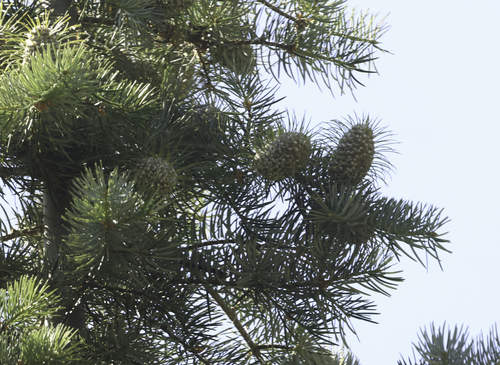
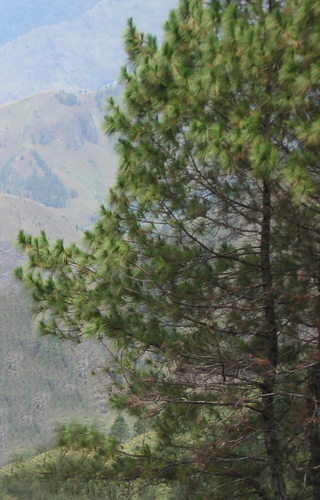
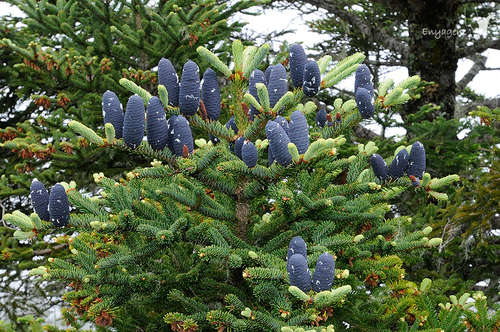
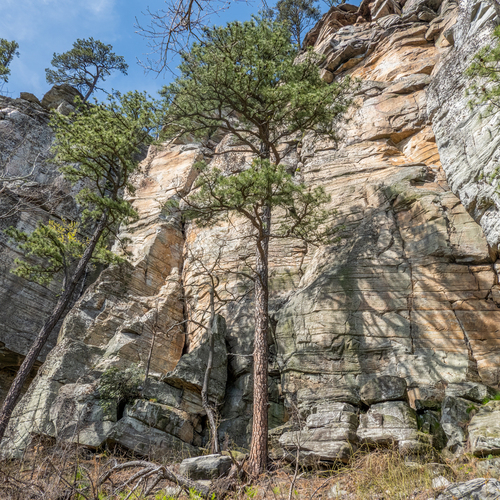
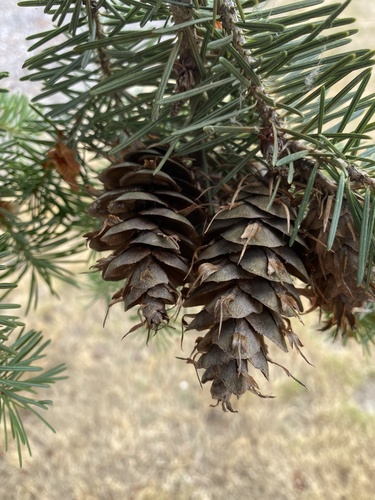
Pseudotsuga menziesii (Mirb.) Franco, commonly known as Douglas-fir, is a species of evergreen tree that grows to a range of sizes from medium to extremely large. Mature trees reach 20–100 m (70–330 ft) in height (only coast Douglas-fir specimens reach near 100 m), and commonly grow to 2.4 m (8 ft) in diameter, with some individual trees reaching diameters of almost 5 m (16 ft). The largest coast Douglas-firs regularly live over 500 years, and the oldest known specimens live for over 1,300 years. Rocky Mountain Douglas-firs, found further inland to the east, are shorter-lived, usually not exceeding 400 years of age. There are historical records of former coast Douglas-firs that exceeded 120 m (390 ft) in height; if these specimens were still alive today, they would make Douglas-fir the tallest tree species on Earth. Two specific historical specimens recorded as exceeding 120 m (400 ft) are the Lynn Valley Tree and the Nooksack Giant. Douglas-fir has flat, soft, linear needles 1.5–4 cm (1⁄2–1+1⁄2 in) long, which generally resemble the needles of true firs. Needles grow singly rather than in clustered fascicles, and they completely encircle the branches, a trait that helps identify the species. When Douglas-firs grow taller in dense forest stands, they shed their lower branches, so foliage may begin as high as 34 m (110 ft) above the ground. Trees growing in more open, high-light environments often retain branches much closer to the ground. The bark of young Douglas-firs is thin, smooth, gray, and marked by numerous resin blisters. On mature trees that are usually over 80 years old, the bark becomes very thick and corky, growing up to 36 cm (14 in) thick with distinctive deep vertical fissures that form as the tree gradually expands. Some sections of mature bark are brown, while other lighter-colored sections have a cork-like texture, and the bark develops in multiple layers. This thick bark makes Douglas-fir one of the most fire-resistant tree species native to the Pacific Northwest. Male Douglas-fir cones are yellowish red, and 5–12 mm (1⁄4–1⁄2 in) long. Female cones are green when young, and mature to reddish-brown or gray, reaching 6–10 cm (2+1⁄4–4 in) long. Unlike the cones of true firs, Douglas-fir female cones are pendulous with persistent scales, and have distinctive long, three-pointed (trifid) bracts that protrude prominently above each scale. These bracts are often said to resemble the back half of a mouse, with two feet and a tail. Douglas-fir seeds are 5 mm (1⁄4 in) long, with a longer wing attached for wind dispersal. The large genome of Douglas-fir was sequenced in 2017 by the large PineRefSeq consortium, which revealed a specialized photosynthetic apparatus in the species' light-harvesting complex of genes. Coast Douglas-fir, Pseudotsuga menziesii var. menziesii, grows in coastal regions from west-central British Columbia south to Central California. In Oregon and Washington, its range is continuous from the eastern edge of the Cascade Range west to the Pacific Coast Ranges and the Pacific Ocean. In California, it grows in the Klamath Mountains and California Coast Ranges as far south as the Santa Lucia Range, with a small stand located as far south as the Purisima Hills in Santa Barbara County. One of the last remaining old-growth stands of conifers is located in the Mattole Watershed, and is currently under threat of logging. In the Sierra Nevada, Douglas-fir ranges as far south as the Yosemite region. It occurs from sea level along the coast up to elevations of 1,500 m (4,900 ft) or higher, and reaches up to 2,100 m (6,900 ft) in some inland locations. A second inland variety exists, Pseudotsuga menziesii var. glauca, commonly called Rocky Mountain Douglas-fir or interior Douglas-fir. Interior Douglas-fir intergrades with coast Douglas-fir in the Cascades of northern Washington and southern British Columbia, and ranges from there northward to central British Columbia and southeastward to the Mexican border. Its range becomes increasingly disjunct as latitude decreases and altitude increases. Mexican Douglas-fir (P. lindleyana), which ranges as far south as Oaxaca, is often classified as a variety of P. menziesii. Fossils of Pseudotsuga (wood and pollen) have been recorded from the Miocene and Pliocene of Europe, at sites including Siebengebirge, Gleiwitz, and Austria. Douglas-fir is also naturalized across Europe, Argentina, and Chile, where it is called Pino Oregón. In New Zealand it is classified as an invasive wilding conifer and is subject to control measures, but it is also one of the most common lumber trees used in commercial forestry alongside Radiata pine, with large plantations across the country. The species was introduced to New Zealand in the 20th century for its wood production. Douglas-fir seeds are an extremely important food source for small mammals including moles, shrews, and chipmunks, which consume an estimated 65% of each annual seed crop. The Douglas squirrel harvests and hoards large quantities of Douglas-fir cones, and also feeds on mature pollen cones, inner bark, terminal shoots, and developing young needles. Mature old-growth Douglas-fir forest is the primary habitat of the red tree vole (Arborimus longicaudus) and the spotted owl (Strix occidentalis). Breeding pairs of spotted owls require home ranges of at least 400 hectares (4.0 km²; 990 acres) of old-growth forest. Red tree voles may also live in immature forests if the forest has a significant component of Douglas-fir with sufficient canopy structure. The red tree vole nests almost exclusively on branches or in the trunks of Douglas-fir, typically 2–50 m (5–165 ft) above the ground, and its diet consists mainly of Douglas-fir needles. Douglas-fir needles are generally poor browse for ungulates, but they can become an important food source in winter when other food is unavailable. Black-tailed deer browse new Douglas-fir seedlings and saplings in spring and summer, and Douglas-fir needles are a prominent part of the spring diet of blue grouse. Douglas-fir leaves are also used by the woolly conifer aphid Adelges cooleyi. This 0.5 mm-long sap-sucking insect is visible on the undersides of leaves by the small white protective wax fluff spots it produces. It often occurs in large numbers, and can cause foliage to turn yellow from feeding damage. In rare cases, trees may be partially defoliated by this aphid, but damage this severe is rare. Among Lepidoptera, aside from general feeders on Pseudotsuga, the gelechiid moths Chionodes abella and C. periculella, as well as the cone scale-eating tortrix moth Cydia illutana, have been recorded feeding specifically on P. menziesii. The inner bark of Douglas-fir is the primary winter food for the North American porcupine. Poriol, a type of flavonoid called a flavanone, is produced by P. menziesii in response to infection by the fungus Poria weirii. Many different Native American groups used Douglas-fir bark, resin, and needles to make herbal treatments for various diseases. Native Hawaiians built waʻa kaulua (double-hulled canoes) from coast Douglas-fir logs that drifted ashore. The wood has historically been preferred as firewood, especially wood from the coastal variety. Early North American settlers used Douglas-fir for all forms of building construction, including floors, beams, and fine carving. Today, the species is widely used in forestry as a plantation tree for softwood timber. Douglas-fir is one of the world's best timber-producing species, and yields more timber than any other species in North America, making the forestlands of western Oregon, Washington, and British Columbia the most productive on the continent. In 2011, Douglas-fir accounted for 34.2% of US lumber exports, totaling 1.053 billion board feet (2,484,803.3 cubic meters). Douglas-fir timber is used for timber frame construction, timber trusses with traditional joinery, veneer, and flooring, valued for its strength, hardness, and durability. As of 2024, the only wooden ships still used for conventional naval operations by the U.S. Navy are Avenger-class minesweepers, constructed from Douglas-fir. Douglas-fir is widely used for heavy timber structures because its wood is strong, available in a range of specifications including kiln-dried and grade-stamped, and can be supplied in very long lengths up to 18 m (60 ft). West coast mills have sophisticated processing for Douglas-fir timbers, leading to predictable lead times and reliable availability. Paints adhere well to Douglas-fir, and stains perform well, though the species' natural color varies so care must be taken to achieve uniform color. Unkiln-dried timbers may contain pitch pockets that ooze resin. Due to the large timber sizes available, standardized stamped grading, and relatively short lead times, Douglas-fir is widely used for both public and residential construction projects. Douglas-fir also has ornamental value for large parks and gardens. It has been commonly used as a Christmas tree since the 1920s, with trees typically grown on plantations for this purpose. Douglas-fir buds have been used to flavor eau de vie, a clear, colorless fruit brandy. Douglas-fir needles can be used to make pine needle tea, have a tangy citrus flavor, and can be used as a wild substitute for rosemary in some recipes.