About Pseudotriton ruber (Sonnini de Manoncourt & Latreille, 1801)
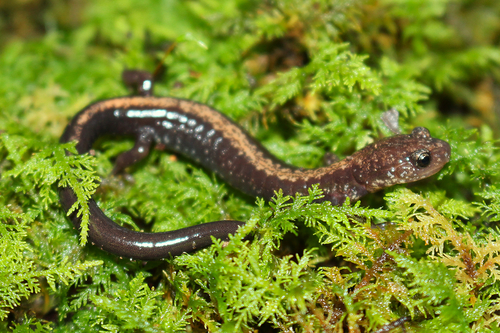
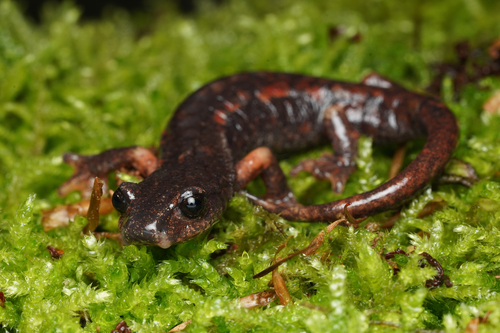
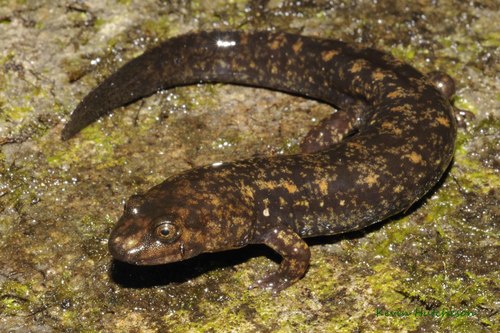
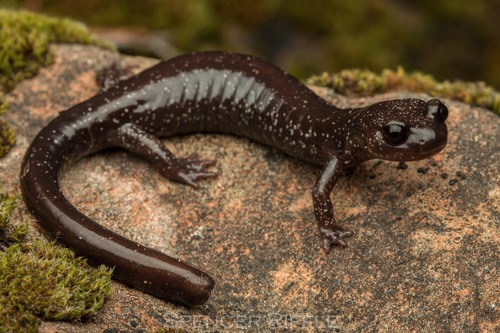
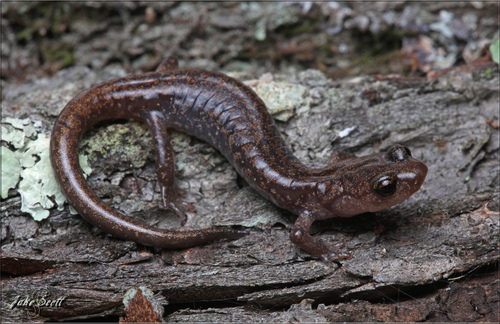
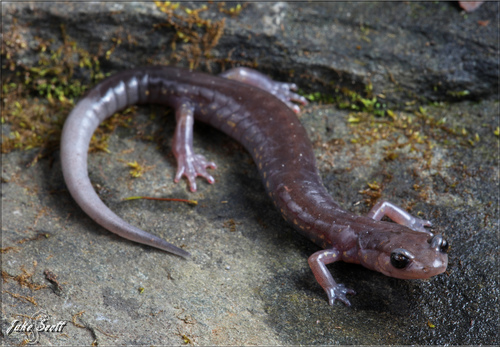
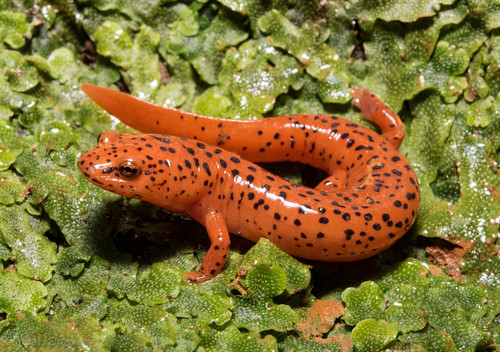
Pseudotriton ruber, the red salamander, is a medium-large salamander species, with adult total lengths ranging from 11 to 18 cm (4.3 to 7.1 in). It has a relatively stout body marked with 16 to 18 costal grooves along its sides. Dorsal color ranges from orange-brown to bright red, and changes with age: older individuals become more darkly pigmented, with patterns growing less distinct. Larvae have a stout head and body, dark base coloration, no spots, and usually have distinct mottling or streaks. A key identifying feature of this species is the presence of many irregular black spots along its back. Despite its distinct appearance, it can sometimes be hard to distinguish from the closely related mud salamander (Pseudotriton montanus), which it forms a Müllerian mimetic complex with via shared bright red coloration. Differences between the two species include spot characteristics, eye color, snout shape, and color contrast between dorsal and ventral surfaces: P. ruber has more, larger spots that often overlap (P. montanus spots are rarely overlapping), a gold-tinted iris marked with a horizontal bar (P. montanus has a brown iris), a less blunt snout, and more uniform color across the back and belly (P. montanus has more contrasting dorsal and ventral coloration). Four subspecies of P. ruber are distributed across the eastern United States, all occupying moist habitats near small, clear water sources such as streams, seepages, and springs, in areas including open fields, meadows, and deciduous or mixed hardwood forests. They are also often found in leaf packets near spring-fed brooks, under moss, and under stones. Subspecies have similar overall appearance with slight differences in size and coloration, and occupy different ranges: the northern red salamander (P. r. ruber) is red or reddish-orange with numerous black spots along its back, it is the most common subspecies, and ranges from southern New York and Ohio to northeast Alabama, plus the Upper Peninsula of Michigan; the Blue Ridge red salamander (P. r. nitidus) is similar in appearance to the northern subspecies but is slightly smaller and lacks black coloration on the chin and tail tip, and occurs at elevations above 5,000 ft (1,500 m) in the southern Blue Ridge Mountains of Virginia; the blackchin red salamander (P. r. schencki) has strong black coloration under its chin, and spotting that extends all the way to the tail tip, and also occurs at elevations above 5,000 ft (1,500 m) in the Blue Ridge Mountains; the southern red salamander (P. r. vioscai) is typically purplish to salmon colored and usually has white spots on its head, and ranges from southern South Carolina to southeast Louisiana and southwest Kentucky. All subspecies avoid large streams, and favor smaller water sources. Ecological studies of P. ruber have covered diet, predation, and life history traits. Larvae are generalist feeders that eat whatever prey is available, primarily consuming invertebrates such as insect larvae and worms. Specific recorded prey composition includes 36.52% Chironomidae, 15.17% Sphaeriidae, 7.87% terrestrial prey, and other salamanders. Larval feeding rates increase with individual size, and increase when water temperature is low; larval growth rates are higher in warmer months when water temperature is higher. Mortality rates are independent of size or age, with annual survival estimated at around 50%. Red salamanders typically lay eggs in fall, and hatching occurs in late fall and winter. The larval period lasts 27 to 31 months, with metamorphosis occurring in spring and early summer of the third year, though larval duration can vary based on environmental conditions, and is shorter at higher elevations. The extended larval period means metamorphosed individuals are much larger than those of many other salamander species, after which the species has a short juvenile period and matures quickly. Size at metamorphosis also decreases with increasing elevation. Males mature at a snout-vent length of 53–63 mm (2.1–2.5 in), usually at four years of age, while females mature at 55–68 mm (2.2–2.7 in), usually at five years of age. Red salamanders are semiaquatic: they occupy springs or streams during winter, disperse between aquatic and terrestrial sites in fall and spring, and stay in terrestrial environments until early spring each year. Adult individuals often live in stream-side burrows, and in moist microhabitats such as under logs and rocks on the forest floor. Adult red salamanders, like larvae, are generalist feeders. They eat invertebrates including earthworms, slugs, snails, spiders, diving beetles, springtails, other insects, and bivalves such as fingernail clams, plus small amphibians including the red-backed salamander. Their predators include birds, small carnivores such as skunks and raccoons, and some snake species. Red salamanders produce unpalatable, distinct-tasting skin secretions that deter predation. As a large salamander species, the presence of P. ruber strongly influences its local ecosystem, so understanding its ecology is important for understanding its role in community structure.