About Pseudotriton montanus Baird, 1850
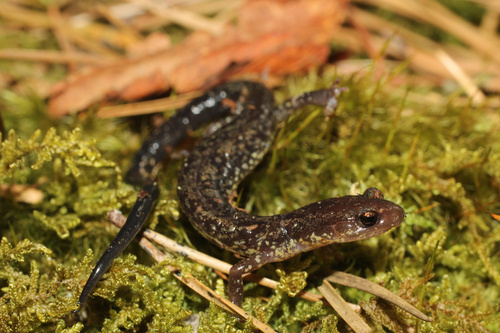
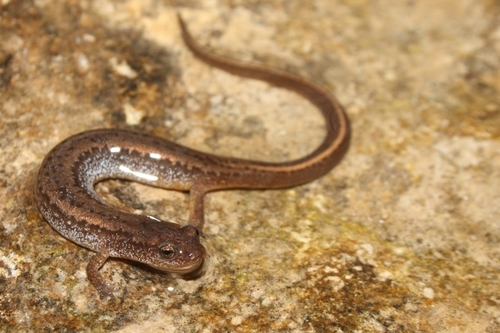
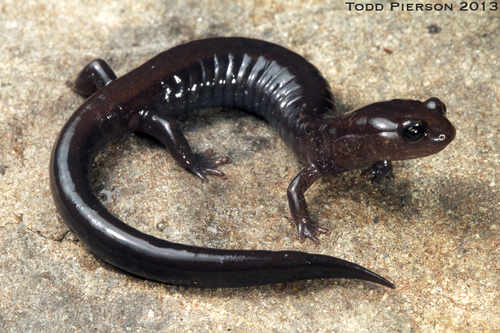
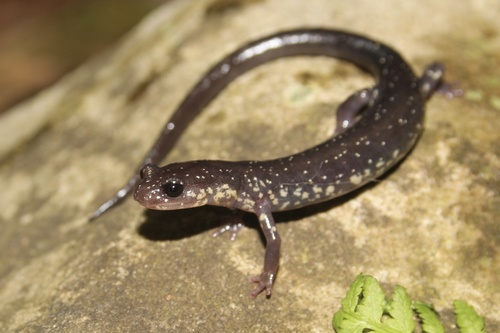
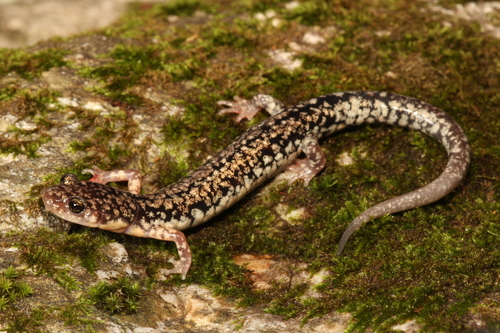
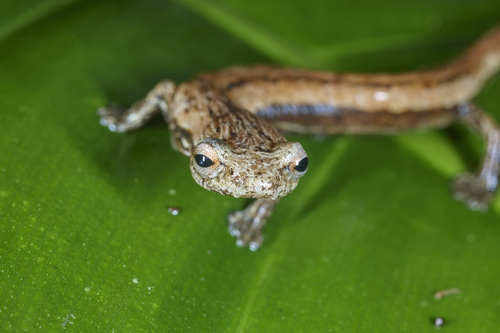
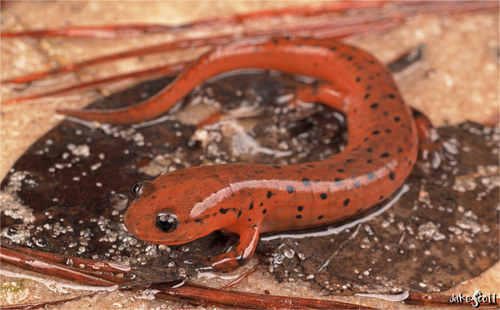
Pseudotriton montanus (mud salamander) larvae are slender and uniformly light in color, with small irregular blotches and flecks of brown pigmentation. Depending on location, the larval stage lasts between 1.5 and 2.5 years. Adult mud salamanders are defined by their reddish-brown color, brown eyes, stocky build, and short tails. By adulthood, they have 30 to 40 distinct round black spots on their backs. Younger mud salamanders are typically bright red, orangish-brown, or crimson, with unmarked stomachs and separated spots. As individuals age, they darken to a dark purplish-red or even brown. Juveniles may gain more spots, while older individuals can have fainter spots or lose their spots entirely. Body color also varies by locality: coastal mud salamanders tend to be darker and more drab, while inland mud salamanders are brighter with more contrast between their base color and the sporadic black polka dots that pattern their bodies. Adult mud salamanders reach lengths of 3 to 8 inches (7.6 to 20.3 cm), are typically stocky, and have 16 to 17 costal grooves along the dorsal sides of their bodies. This species is easily confused with two other species: the red salamander (Pseudotriton ruber) and the spring salamander (Gyrinophilus porphyriticus). It can be told apart from the red salamander by its eyes and snout: mud salamanders have dark brown eyes and a short snout, while red salamanders have golden yellow eyes and a long snout. Mud salamanders also have widely separated dorsal spots, whereas red salamanders have spots that are closer together. Mud salamanders are distinguished from spring salamanders by their shorter body length and the lack of the nasal ridge found on spring salamanders. The mud salamander produces a proteinaceous skin toxin along the back of its body that can cause extreme irritability, hypothermia, and physical weakness in predators. Mud salamanders live in low-elevation swamps, bogs, seeps, springs, and streams that have a muddy bottom and clean, clear water. This is a burrowing species that shelters in burrows beneath leaf litter, logs, stones, or bark, and may also build tunnels in creek banks. These amphibians spend most of their lives close to water, but also burrow into soil in the surrounding area. Larvae are usually underground in muddy springs; they are often found in leaf litter, debris, and muck of muddy springs, seeps, and streams. After they lose their gills and become adults, they create burrows in muddy areas. They often use existing crayfish burrows, and will sit with their heads sticking out of these burrows waiting for prey to pass. They leave their burrows at night to forage in the surrounding area. In general, mud salamanders do not wander as far from their main habitat as their close relative, the red salamander. Mud salamanders appear to favor small, muddy seeps and springs that dry up in summer. Both larval and adult mud salamanders move deep underground during the hottest summer months, especially in small drying springs and seeps. Gilled larvae go deep into mud where water remains underground, while adults stay deep in burrows. During the hottest times of year, they are usually only found at night or during rain, when they forage for a short time before returning to their burrows in the mud. Dusky salamanders are often found in the same habitat as mud salamanders and are much easier to locate. In these cases, the more abundant dusky salamanders often serve as a food source for mud salamanders. Small muddy springs inhabited by mud salamanders often feed into larger streams that hold more common species such as dusky and two-lined salamanders. In this scenario, mud salamanders will venture into the main stream and can often be found there, as they search for more food outside their smaller primary habitat. This occurs because there is less competition outside the smaller habitat that already holds many mud salamanders, and because abundant two-lined and dusky salamanders are available as prey for the larger mud salamanders. They can often be found in creeks that do not seem like ideal habitat for them, because they have left their primary habitat to seek food. An ideal muddy habitat is almost always within close proximity to where a mud salamander is found in a non-ideal stream. Mud salamanders breed during the warmer months of the year, and egg deposition most commonly occurs during autumn and winter. Females reproduce at most once per year, usually once every two years, while males may breed several times a year. It is thought that the females' irregular reproductive cycle is a facultative adaptation that prolongs life during variable mortality rates and increases overall reproductive success. Females of this species produce extremely large egg clutches for a plethodontid salamander. When a mate is found, the male performs a tail undulation display. The female then straddles his tail, allowing glands on the male's tail to lubricate her, after which the male is able to deposit his sperm into the female. Females reach reproductive maturity around four to five years old, while males reach reproductive maturity around two to two and a half years old. Males reach sexual maturity in their first year after metamorphosis, but only reach breeding condition after a few summers. Males breed every year, while females typically breed every other year. Males produce sperm annually and attempt to mate between July and November, and females begin oviposition in the fall. A female may stay with her eggs to assist with the incubation process. Incubation typically lasts three or more months, and embryos hatch in winter. Clutch sizes range from 65 to 200 eggs, and clutch size increases with female body size. P. montanus has greater fecundity than the red salamander.