About Pseudotrapelus sinaitus (Heyden, 1827)
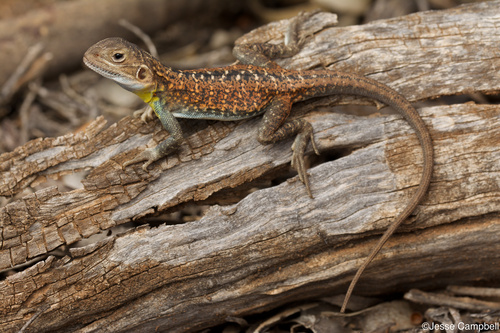
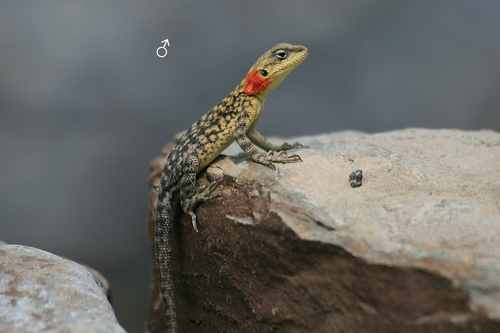
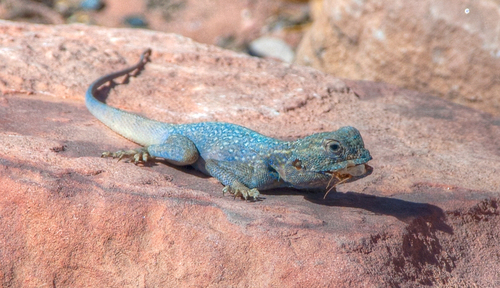
The Sinai agama (Pseudotrapelus sinaitus) is a small lizard with long legs that give it an upright stance. It reaches a total length of 18 cm (7 in), with a long, slender tail that is one and a half times the length of its body. It has a long head, with eyes positioned fairly close to the front, and a distinct pair of ear openings located some distance behind the eyes, aligned with the mouth. Its legs are long and slender, and it often holds its tail off the ground. This species is generally dull brown in overall color. During the breeding season, males turn bright blue; sometimes only the head and throat turn blue, while the rest of the body stays brown. Females and juveniles remain greyish-brown year-round, and females typically have a crescent-shaped red patch on each side of the body just behind the forelimbs. The scales on the lizard's dorsal (back) surface are relatively small, uniformly overlapping, and slightly keeled. Scales along the mid-back are slightly larger than scales elsewhere on the back, and tail scales are larger than back scales. Unlike closely related lizards of the genus Agama, the third (middle) toe of the Sinai agama is the longest, rather than the fourth toe. The Sinai agama inhabits arid regions of northeastern Africa and the Middle East. It occurs on Egypt's Sinai Peninsula, as well as in Jordan and Syria.