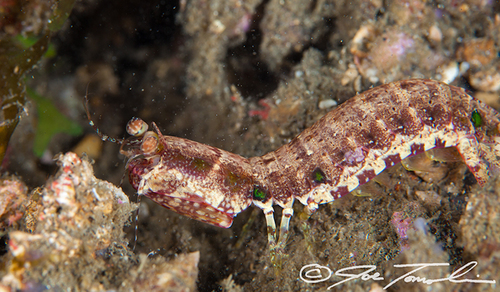
About Pseudosquilla ciliata (Fabricius, 1787)
Pseudosquilla ciliata (Fabricius, 1787) can be distinguished from other closely related mantis shrimps by several distinct traits: its eye is cylindrical with a hemispherical cornea; the rostral plate does not have a small spine at its front; the carapace lacks large black spots; the telson has three keel-like ridges on each side of a central ridge; and the base of each uropod ends in two slender flattened spines, with the innermost spine being the shorter of the two. The body colour of P. ciliata varies widely based on the individual’s surrounding environment. For example, individuals living in seagrass flats often turn green, while those living on coralline algae often turn red. This species may reach a total body length of 95 millimetres (3.7 in). Its overall colour can range from yellowish to nearly black, and may be plain, marbled or striped. There is commonly a dark patch on the last thoracic segment and the first abdominal segment, and an additional dark patch on the edge of the telson just behind the intermediate spine on the sixth abdominal segment. P. ciliata has a widespread distribution across shallow tropical seas, covering the tropical Indo-Pacific region and both sides of the Atlantic Ocean. It creates burrows in sandy and muddy areas and in seagrass meadows. It can also be found on coral rubble, under boulders, and on rocky reef flats. It occurs across a depth range from the lower shore down to at least 86 m (282 ft). This species is sometimes kept in reef aquaria, where it is hardy and safe to keep with larger gastropods and crabs. Providing a sand base in the tank gives it the opportunity to dig the U-shaped burrow that it prefers to spend its days in.

