About Pseudoseisura unirufa (Orbigny & Lafresnaye, 1838)
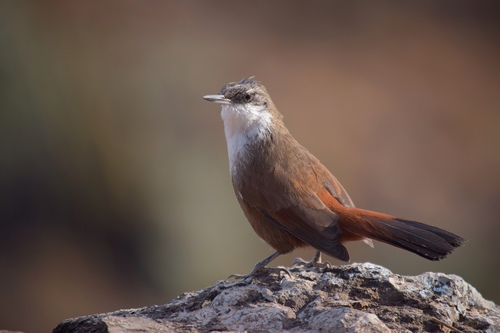
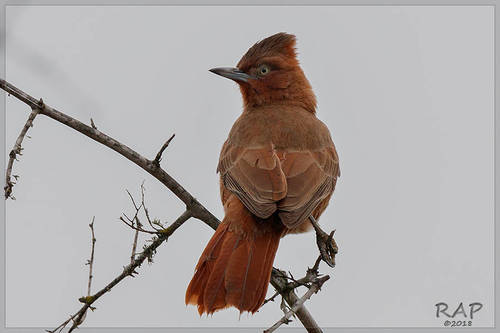
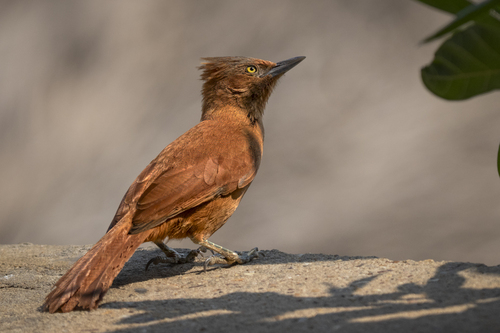
The grey-crested cacholote (scientific name Pseudoseisura unirufa (Orbigny & Lafresnaye, 1838)) is a large crested furnariid. It measures 20 to 21 cm (7.9 to 8.3 in) long and weighs 42 to 57 g (1.5 to 2.0 oz). Males and females have identical plumage. Adults are mostly bright reddish-rufous, with slightly paler coloration on their underparts. Their crest can range from entirely rufous to almost entirely grayish. The center of their throat has an orange tinge. Their flight feathers have fuscous tips, and the ends of their tail feathers lack barbs. Their iris is yellow to buff-yellow, their bill is blue-gray to gray with a paler mandible, and their legs and feet are olive to greenish gray. Juveniles have a shorter crest than adults and less uniform overall coloration. The Caatinga cacholote, which was formerly considered conspecific with this species, is similar in appearance but larger, and has no gray in its crown. The grey-crested cacholote has a disjunct distribution. One population occurs in Beni Department and extreme northwestern Santa Cruz Department in north-central Bolivia. The other population is found in southeastern Santa Cruz (Bolivia), the Brazilian states of Mato Grosso and Mato Grosso do Sul, and northern Paraguay. This species lives in gallery forest, woodlands, and seasonally flooded savanna within the Pantanal, and is frequently found near human dwellings. It occurs at elevations between 300 and 500 m (1,000 and 1,600 ft).