About Pseudoseisura cristata (Spix, 1824)
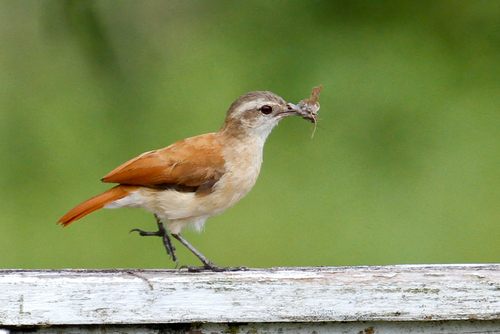
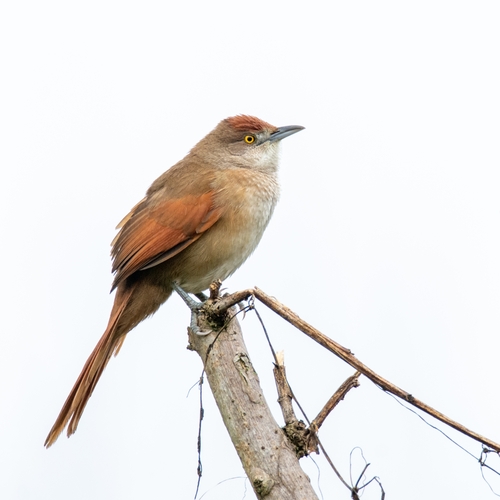
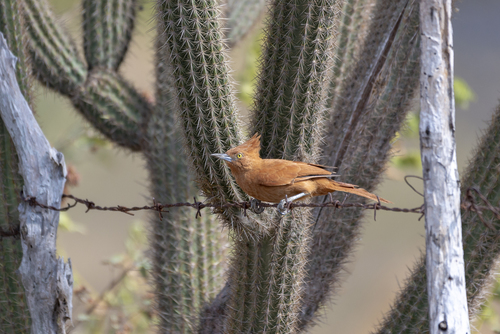
The Caatinga cacholote, scientifically named Pseudoseisura cristata (Spix, 1824), measures 25 to 26 cm (9.8 to 10 inches) in length. It is a large, crested furnariid with a long bill. Males and females share identical plumage patterns. Adult individuals are mostly bright reddish-rufous, with slightly paler underparts. Their flight feathers have fuscous tips, and the ends of their tail feathers lack barbs. Adults have yellow irises. Juveniles have a shorter crest than adults, with some dusky streaks or bars on the face and underparts, and a bluish gray iris. This species is found in eastern Brazil, in a region roughly bounded by eastern Maranhão, Paraíba, and central Minas Gerais. It inhabits the woodlands and scrub of the Caatinga biome, and also occurs in tropical deciduous forest. Outside areas with dense human populations, it is commonly found around human dwellings. Its elevation range spans from 50 to 500 m (160 to 1,600 ft).