About Pseudopodoces humilis (Hume, 1871)
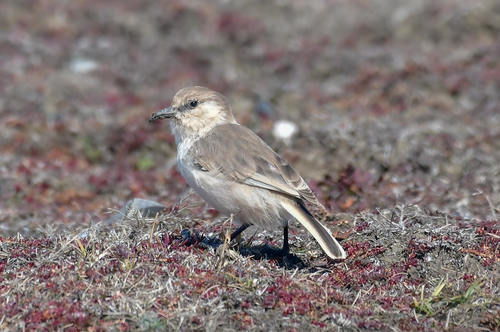
Pseudopodoces humilis, commonly known as the ground tit, resembles unrelated ground jays of the genus Podoces in general appearance, but it is much smaller — about the size of a house sparrow, Passer domesticus — and it has no prominent markings. More clearly, its overall build is similar to that of a wheatear in the genus Oenanthe, but it has no black feathers. It has a strong, slightly downcurved bill that matches the shape of a chough’s bill (Pyrrhocorax), though it does not share the same colour. Its soft, loose body plumage blends in extremely well with its natural habitat. The bird’s underside is coloured greyish-fawn with a tawny tone. The upperparts are mostly a darker fawn-brown, while the central tail feathers and primary flight feathers are a little darker still. The head matches the underside’s colour, with a darker cap and a light patch on the nape, a pattern that is quite similar to that of some tits, especially those in the genera Parus sensu stricto and Periparus. The bill, legs and feet are black, and males and females look identical. Its voice is described as a plaintive whistling cheep-cheep-cheep-cheep, and it also produces a two-syllable finch-like call. This species occurs across the Tibetan Plateau of China, extending into the adjacent areas of western Sichuan and Gansu. It inhabits open alpine steppe, and sometimes more arid regions with small scattered shrubs, and almost never occurs below 3,000 metres above sea level. It is not found anywhere that dense vegetation, especially trees, is the dominant vegetation type. It does not have strong flight, and flies low over the ground. It prefers to escape quickly by running or jumping when approached. It moves across the ground in unpredictable hops and bounces that can be quite long: it can achieve jumps three times its own body length without using its wings, unlike Podoces ground jays which move by striding or running. Observers have compared the sight of a moving ground tit to a small greyish-brown rubber ball. It forages for food on the ground, eating a wide variety of arthropod prey. It often gathers prey by probing and turning over yak dung (Bos grunniens) to flush prey out. It also looks into rock crevices and ground holes when searching for food. Individual ground tits have been observed poking at mud in and near puddles, similar to the behaviour of hoopoes (Upupa epops). In general, the bill is used extensively for digging, much like the similarly shaped larger bill of the red-billed chough (Pyrrhocorax pyrrhocorax). When chased by a bird of prey or other predator, it will bolt straight down the nearest hole like a rodent, staying there until the danger passes. Ground tits are often found near pika colonies (Ochotona). While both the birds and mammals likely benefit from each other’s vigilance, their association is probably not the result of strong mutualism, and instead stems from both species preferring habitat with similar ground cover and soil. Its nest is unusual for a passerine, as it is built inside a burrow that the birds excavate themselves. The burrow is usually dug horizontally into a bank or earthen wall, and can reach a depth of 1.8 metres. The nest sits at the end of the burrow in a small chamber, and typically consists of a small amount of wool placed on a base of grass. The clutch holds 4–6 pure white eggs. Young ground tits stay with their parents for some time after fledging, and half-grown young are still occasionally fed by their parents as late as August. This species practices cooperative breeding: monogamous pairs often have at least one male helper, which is a yearling that remains on its natal territory. This behaviour is thought to occur because of a shortage of males in the population. The ground tit is not migratory, but it may descend to lower altitudes in valleys during winter. In addition to digging nesting burrows, ground tits often dig roosting burrows to use during the coldest months of the year.