About Pseudopleuronectes americanus (Walbaum, 1792)
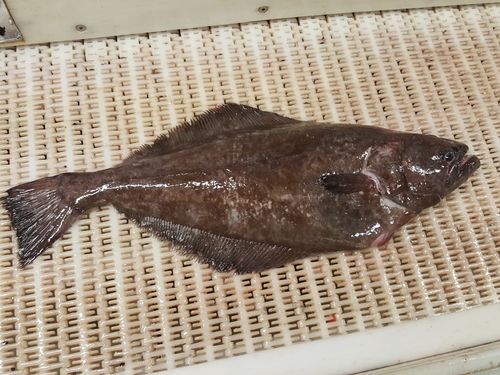
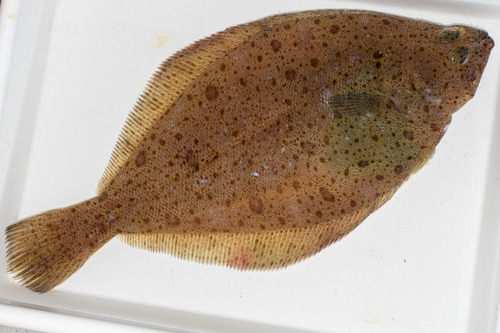
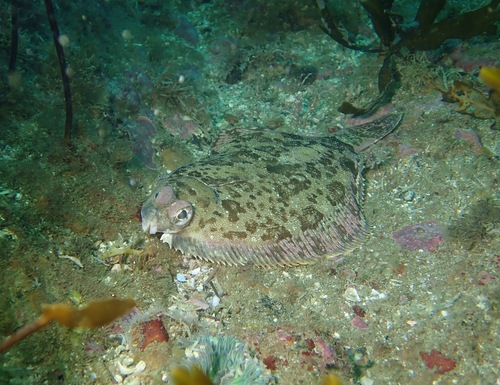
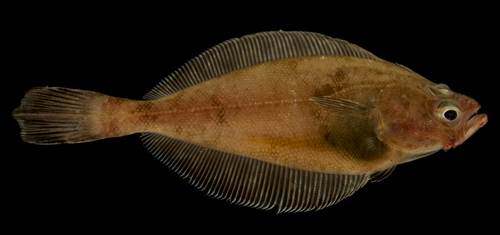
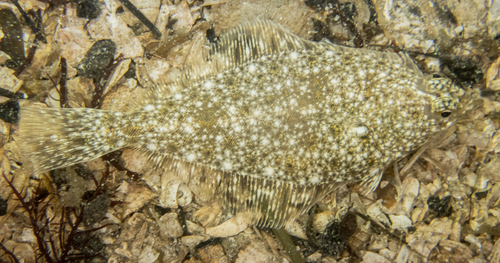
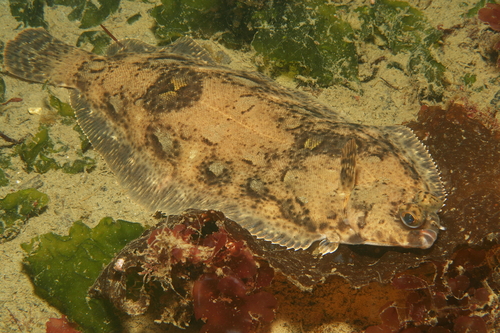
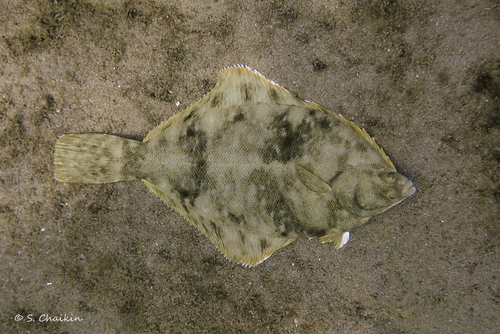
Pseudopleuronectes americanus, commonly called the winter flounder or black back, is a right-eyed (dextral) flatfish belonging to the family Pleuronectidae. This species is native to the coastal waters of the western North Atlantic coast, ranging from Labrador, Canada to Georgia, United States. It is less common in waters south of Delaware Bay, and it is the most abundant near-shore shallow-water flounder from Newfoundland down through Massachusetts Bay. Overall, the species reaches a maximum length of around 61 cm and maximum weight of 2.25 kg, but individuals grow larger on Georges Bank, where they can reach 70 cm in length and 3.6 kg in weight. While winter flounder historically supported large commercial and recreational fisheries, both the species' total biomass and annual landings have decreased since the 1980s. Winter flounder produce up to 3.3 million demersal, adhesive eggs that remain within their spawning grounds. Depending on water temperature, larvae that measure approximately 3 mm in length hatch within two to three weeks. These larvae start out as planktonic, and gradually transition to a bottom-dwelling lifestyle as they develop. Around five to six weeks after hatching, the larval flounder's left eye begins to migrate to the right side of its body. After this transformation, flounder-like juveniles settle onto the seafloor and move into saltwater coves, coastal salt ponds, estuaries, and protected bays. Within their first year of life, juveniles can grow up to 100 mm in length. Adult winter flounder can grow as large as 70 cm and live for more than 15 years. Growth rates vary across the species' range, with northern populations generally growing more slowly than populations at the southern end of the range. Winter flounder reach sexual maturity at around two to three years of age, when they reach a total length of 25–30 cm, though this timing and size varies across their distribution. For mature adults outside of Georges Bank, migration generally occurs in two phases: adults enter shallow estuaries in late fall and early spring to spawn in late winter or early spring, then return to deeper parts of the estuary or offshore waters after spawning. These migration patterns can be altered, and some individuals may stay inshore year round if water temperatures stay at 15 °C or lower, or if enough food is available. Genetic analyses and tagging studies confirm that there is very little mixing between winter flounder populations in the Gulf of Maine, south of Cape Cod, and on Georges Bank.