About Pseudopanax linearis (Hook.fil.) K.Koch
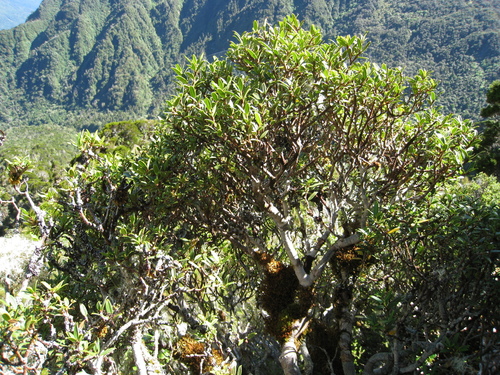
Pseudopanax linearis (Hook.fil.) K.Koch is a heteroblastic shrub or small tree. It typically reaches 3 m (9.8 ft) in height, though it can grow as tall as 5–7 m (16–23 ft), with a trunk up to 15 cm (5.9 in) in diameter. As a heteroblastic species, it transitions from juvenile to adult leaf forms once it reaches approximately 1–2 m (3 ft 3 in – 6 ft 7 in) above ground level.
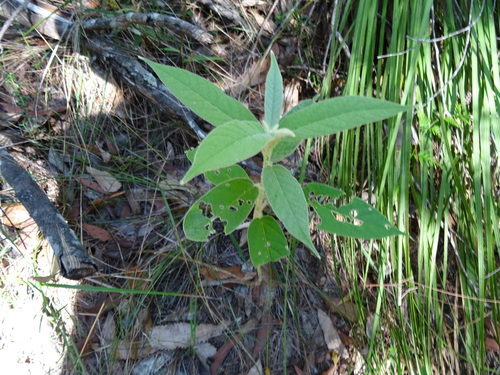
Juvenile leaves are very thick, narrow, and linear, measuring 15–25 cm (5.9–9.8 in) long and 0.5–1 cm (1⁄4–1⁄2 in) wide, and grow from a short, thick petiole. The upper surface of juvenile leaves is dark green or brown, while the underside is pale to dark brown. Juvenile leaves have a crenate-serrate toothed margin and a strongly raised, pale-pink midrib 1–1.5 mm wide, and they grow ascending, either horizontally or upwards.
Adult leaves are shorter and slightly wider than juvenile leaves, at 5–10 cm (2.0–3.9 in) long and 0.75–1 cm (1⁄4–1⁄2 in) wide. They remain thick but are linear-lanceolate in shape, with a leaf tip that is either rounded obtuse or pointed acute. Adult leaves grow from thick 5 mm-long petioles, and have margins that are either less prominently toothed or entirely smooth. All leaves are simple and alternate, and adult leaves typically grow crowded at the tips of branchlets.
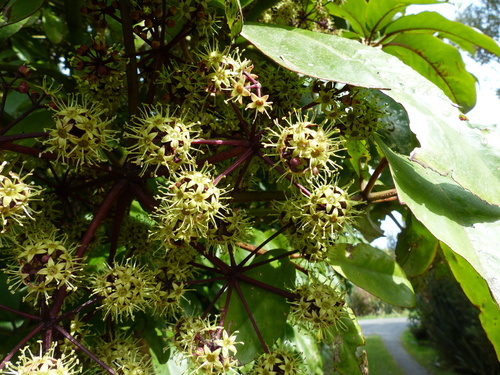
Pseudopanax linearis produces flowers in small, compound umbels that grow terminally, or sometimes axillary. Flowers attach to short peduncles or grow directly from the plant's stem. Individual flowers are small, 5 mm in diameter, and pale yellow-green. Male flowers have five stamens and five petals. Female flowers have a 3–5-celled connate (joined at the base) style with backward-curving tips, a 3–5-loculed ovary, and no petals.
Ripe fruits are purple, oblong to ovate in shape, around 5 mm long, and contain 3–5 locules. The bark of Pseudopanax linearis is smooth and pale grey. Juvenile plants are slender and unbranched, while mature adults have a small crown with a small number of spreading branches.
Pseudopanax linearis is endemic to New Zealand, where it is only found in the South Island. It occurs mostly on the western divide of the South Island, generally west of the Southern Alps, ranging from north-west Nelson to Southland. It grows in subalpine scrub to montane high-altitude forests in damper areas of the South Island, as a canopy or subcanopy species. It is commonly called mountain lancewood, as it is considered the high-altitude equivalent of lancewoods. It often grows in association with silver beech, and has been found growing on imperfectly drained soils and gley podzol soils, which are associated with high rainfall. Flowering occurs in summer, around January. Flowers are pollinated by insects, and seeds are dispersed by birds.