About Pseudonigrita cabanisi (Fischer & Reichenow, 1884)
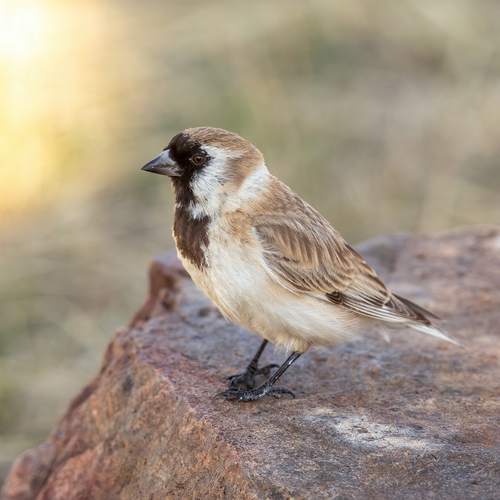
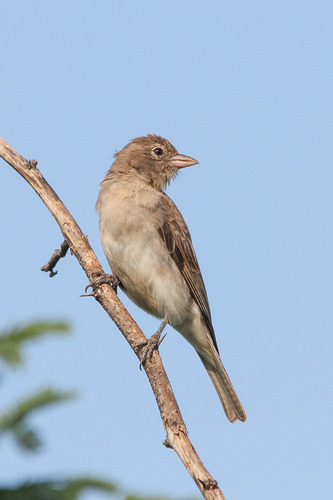
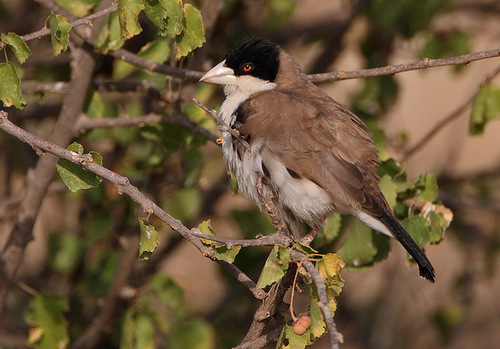
The black-capped weaver, Pseudonigrita cabanisi, measures 13 cm (5.1 in) in length and weighs 18–24 g (0.63–0.85 oz). Adult individuals have a large, clearly defined black cap that extends from the base of the bill, across the crown to the back of the neck, and also covers the area around the eye and ear. The neck, mantle, wings, and rump are uniformly brown, while the tail is blackish brown. The throat, sides of the neck, breast, belly, and vent are white. A distinct, narrow longitudinal black stripe runs along the center of the belly down to the stomach. There are also black feathers on the sides of the breast, but these are often hard to observe, as they may be partially or fully covered by the wings. The legs are dark horn-colored, the bill is ivory-colored, and the eyes are bright red. Juvenile birds lack all black markings; their markings are instead the same brownish color as the mantle and wings. Juveniles have a horn-colored bill and a dark brown iris. Pseudonigrita cabanisi is distributed across central and southern Ethiopia, most of Kenya, a section of Somalia near the tripoint border with Ethiopia and Kenya, and northern Tanzania. It prefers semi-arid savannas dominated by acacias and other thorny bushes. This species is monogamous and breeds in colonies. It feeds mainly on grass seeds, but also eats succulent vegetation to meet its water requirements, and consumes insects, especially to feed its nestlings.