About Pseudonaja affinis Günther, 1872
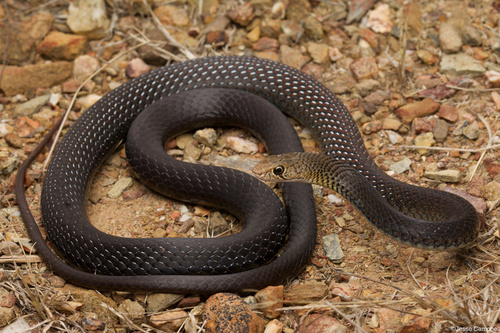
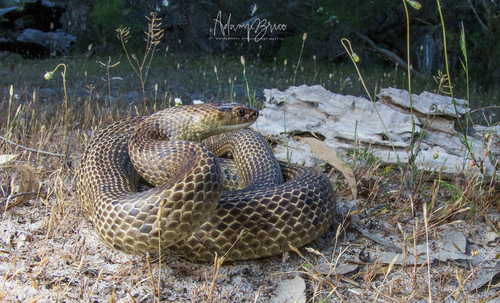
The dugite (Pseudonaja affinis Günther, 1872) is a venomous, dangerous snake. Its body colour ranges from grey, green to brown; colouration varies widely between individuals, and is not a reliable way to identify the species. Black scales may be scattered across the body. Its scales are relatively large with a semi-glossy finish. The most notable distinguishing feature is its small head, which is not clearly distinct from the neck. The dugite has a long, slender body build; it can reach a total maximum length of 2 metres (6 ft 7 in) including the tail, with a typical total length of roughly 1.5 metres (4 ft 11 in). Pseudonaja affinis is distributed across southern Western Australia and remote coastal areas of western South Australia. It can live in a wide range of habitats, including coastal dunes, heathlands, shrublands and woodlands. It also thrives in heavily degraded habitats like golf courses, industrial areas and open agricultural farmlands. After natural habitats were opened up and the house mouse (its main food source) was introduced, the dugite's population has grown. In the Perth metropolitan area, the dugite is one of the most common snakes found near buildings. In areas populated by humans, it takes temporary shelter under items such as concrete slabs, fibro sheeting and roofing tin. In more natural habitats, it shelters under rocks and in abandoned termite mounds. It also burrows underground during the winter. Like all brown snakes, the dugite normally mates between early September and late November. It is an oviparous (egg-laying) species. It typically lays around 30 eggs, then abandons them to self-incubate. Eggs hatch after approximately 65 days. When environmental conditions are optimal, the dugite may lay two clutches of eggs in a single breeding season.