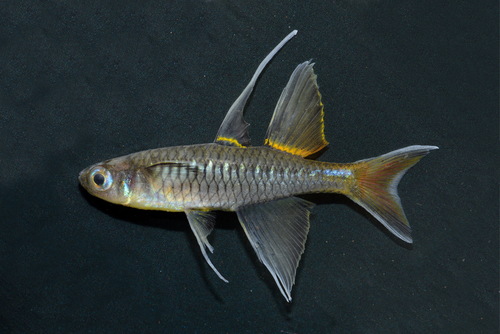
About Pseudomugil signifer Kner, 1866
Pseudomugil signifer, commonly known as the Pacific blue-eye, generally reaches a total length of 3–3.5 cm (1+1⁄8–1+3⁄8 in); the maximum recorded length is 8.8 cm (3+1⁄2 in) for males and 6.3 cm (2+1⁄2 in) for females. For populations of Pacific blue-eye found north of the Burdekin Gap, body size increases directly with distance from the gap, and males and females grow to the same maximum size. South of the Burdekin Gap, this species shows a marked size difference between sexes, and this difference becomes more pronounced the further the population is from the gap. Its body is elongated, partly transparent, and pale yellow or olive in color, with a silver operculum (gill cover) and silver belly. Its scales are relatively large, and longer vertically than they are horizontally. It has a large eye with a blue iris. It has two dorsal fins; the first dorsal fin arises in line with, or just posterior to, the longest pectoral fin ray. Its tail fin is forked with rounded tips, and the top and bottom edges of the tail fin are edged in white. Males have extended fin filaments on their dorsal, anal, and pelvic fins. They have black markings at the base of the anterior rays of their anal fin and rear dorsal fin; the anterior edge of these fins is sometimes white, and the posterior edge is greyish. A male’s fins may turn orange during the breeding season. Preserved specimens of this species generally discolor to yellow or tan. The Pacific blue-eye can be distinguished from the highly invasive, noxious introduced eastern mosquitofish (Gambusia holbrooki) by its forked tail fin. The Pacific blue-eye is distributed from Narooma in southern New South Wales north to the Rocky River in Cape York, though it is uncommon in eastern Cape York. It inhabits small, generally slow-moving streams, estuaries, dune lagoons, and salt marshes. It is also found in brackish and marine waters around several Queensland offshore islands, including Hinchinbrook Island, Lizard Island, Low Island, and Dunk Island. It has been recorded as far as 300 km (185 mi) upstream in Queensland’s Mary and Dawson Rivers. Population numbers can be very high in some locations, such as the Mary River, while the species is uncommon in the Elliott and Kolan Rivers. Fish species that the Pacific blue-eye is commonly found alongside include Marjorie's hardyhead (Craterocephalus marjoriae), crimson-spotted rainbowfish (Melanotaenia duboulayi), Australian smelt (Retropinna semoni), and western carp gudgeon (Hypseleotris klunzingeri). In the wet tropics, the Pacific blue-eye is mostly found in streams with flow rates up to 30 cm (12 in) per second, and rarely in streams with flow rates up to 90 cm (35 in) per second. In fast-flowing sections of these streams, it shelters in slower water (flowing less than 20 cm (8 in) per second), sometimes in the lower half of the water column or in the lee of underwater rocks. Further south in southeastern Queensland, the species is mostly found in water flowing slower than 10 cm (4 in) per second. It can also live in tidal pools that become isolated from rivers at low tide. The Pacific blue-eye forages in mangroves. A field study conducted in waters around Hinchinbrook Island and near Ingham on nearby mainland Queensland found that the species enters mangroves with the incoming tide as soon as the water is deep enough to swim in, but leaves again an hour later because it stays in shallow water areas. A field study of two lakes polluted by coal mine runoff in central Queensland found that the Pacific blue-eye was more resistant to adverse health effects from the pollution than tadpoles of the striped marsh frog (Limnodynastes peronii). While the fish did not suffer acute health impacts, they showed markers of long-term compromised health.

