About Pseudoleistes guirahuro (Vieillot, 1819)
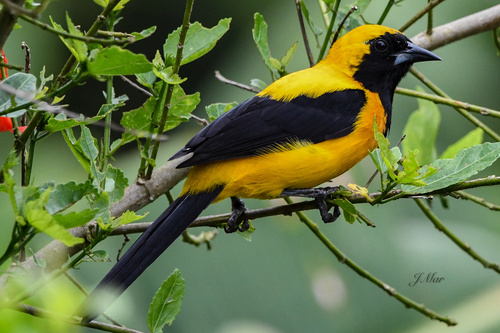
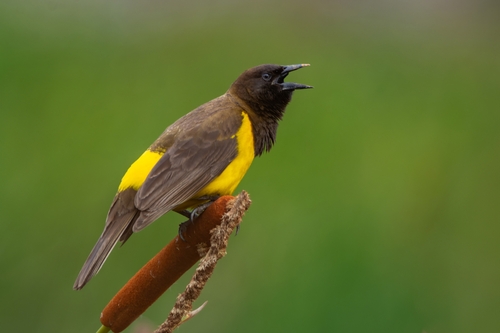
The yellow-rumped marshbird, scientifically named Pseudoleistes guirahuro (Vieillot, 1819), gets its common name from the yellow coloration of its belly, flanks, thighs, and rump. It has a blackish head, and its breast, back, and wings are blackish brown. This species shows slight sexual size dimorphism: males have an average weight of 91.2 g, while females average 81.9 g. The yellow-rumped marshbird occurs in southeastern Brazil, eastern Paraguay, northern Uruguay, and the Misiones and Corrientes provinces of northeastern Argentina. Its range within Brazil overlaps with the range of the brown-and-yellow marshbird. It occurs most often in shrubby marsh or moist grasslands, and it avoids treeless habitats. The yellow-rumped marshbird feeds on ground-dwelling arthropods and small vertebrates. For most of the year, this gregarious marshbird forms flocks of 10 to 20 individuals. Between September and November, single pairs can be observed, which marks the start of the breeding cycle. During this initial stage, one member of the pair gathers nest materials, inspects potential nest sites, and builds the nest, while the other individual produces short songs. After eggs are laid, three to four adult marshbirds guard the nest and bring food to the chicks. This confirms that yellow-rumped marshbirds are regular cooperative breeders.