About Pseudolabrus luculentus (Richardson, 1848)
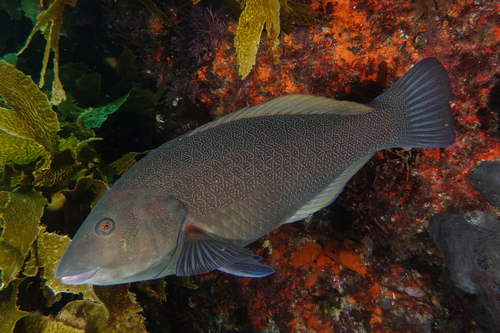
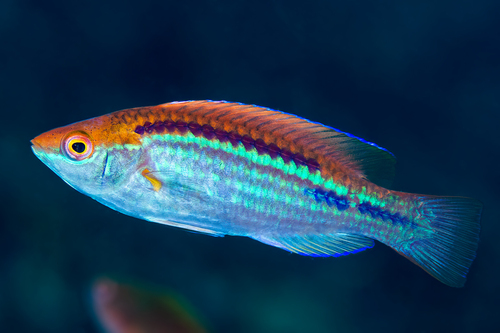
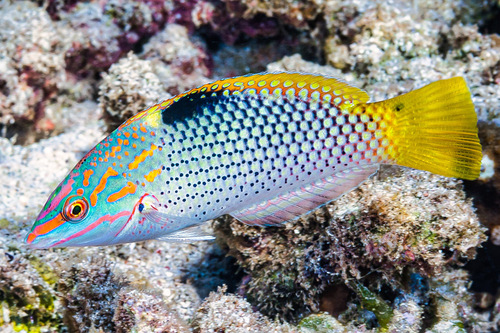
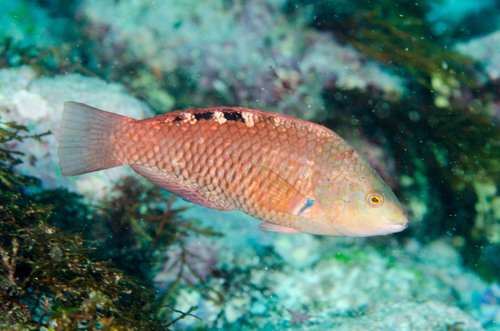
This species has the scientific name Pseudolabrus luculentus (Richardson, 1848), commonly called the orange wrasse. In terms of morphology, females and juveniles are primarily orange, with five vertical white bars across their bodies and yellow markings on their heads. Females additionally have yellow dorsal and anal fins, white spots or lines on the lower half of the body, and white horizontal stripes below the eyes. Males are red-brown, and have black-and-white square patterns beneath the rays of their dorsal fin. Orange wrasses live in temperate marine habitats near New Zealand, found around the Kermadec Islands, Norfolk Island, the Three Kings Islands, and the North-East North Island. They have also been recorded at Lord Howe Island and in New South Wales. At Boat Cove in the Kermadec Islands, this species is the most common fish on the reef. Shallow water here hosts densities of up to 37 individuals per 500 m², while deep water holds densities of up to 30 individuals per 500 m². In Boat Cove, juveniles make up 70% of the shallow water population (found at 3 to 6 meters depth) and 85% of the deep water population (found at 14 to 20 meters depth). Other species of wrasse are also abundant at Boat Cove. Regarding reproduction and life cycle, orange wrasses form breeding pairs and are oviparous: their eggs hatch after being laid. Females spawn from March to October, and surviving offspring mature after one year. This species is a protogynous hermaphrodite, meaning females can change sex to become males.