About Pseudois nayaur (Hodgson, 1833)
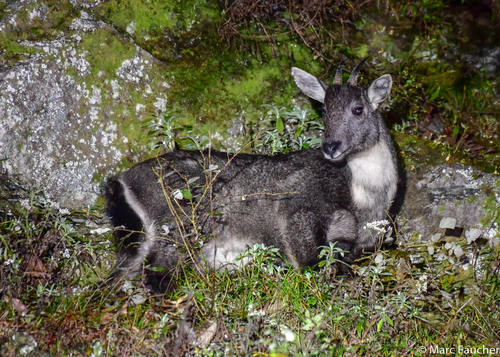
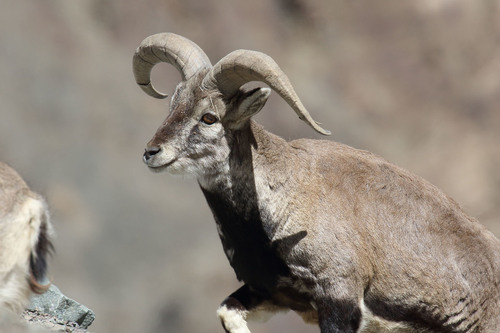
Pseudois nayaur, also known as bharal, are medium-sized caprids. Their head-and-body length ranges from 115 to 165 cm (45 to 65 in), with a tail length of 10 to 20 cm (3.9 to 7.9 in). They measure 69 to 91 cm (27 to 36 in) tall at the shoulder, and their body mass ranges from 35 to 75 kg (77 to 165 lb). Males are slightly larger than females. They have a dense coat that is slate grey, sometimes with a bluish sheen. Their underparts and the backs of their legs are white, while their chest and the fronts of their legs are black. A charcoal-colored stripe separates the grey back from the white belly. Their ears are small, and the bridge of the nose is dark. Both sexes grow horns, which have ridged upper surfaces. In males, horns first grow upward, then turn sideways and curve backward, giving them an appearance somewhat like an upside-down mustache; they can reach a length of 80 cm (31 in). In females, horns are much shorter and straighter, growing up to 20 cm (7.9 in) long. Bharal are active throughout the day, alternating between feeding and resting on grassy mountain slopes. Because they have excellent camouflage and their environment has no protective cover, bharal stay completely motionless when approached. If they are noticed, they quickly run up steep precipitous cliffs and freeze there again, using their camouflage to blend into the rock face. Population densities recorded in Nepal are 0.9 to 2.7 individuals per square kilometer. Densities reach a maximum of 10 animals per square kilometer in winter, when herds gather together in valleys. Bharal are mainly grazers, but when grass is scarce, they switch to browsing and eat forbs and shrubs. There is a high degree of diet overlap between bharal and livestock, especially donkeys. Combined with density-dependent forage limitation, this overlap causes resource competition and a resulting decline in bharal population density. Where their ranges overlap, bharal are the preferred prey of snow leopards, Himalayan wolves, and leopards. A small number of bharal lambs are preyed on by foxes or eagles.