About Pseudodiploria clivosa (Ellis & Solander, 1786)
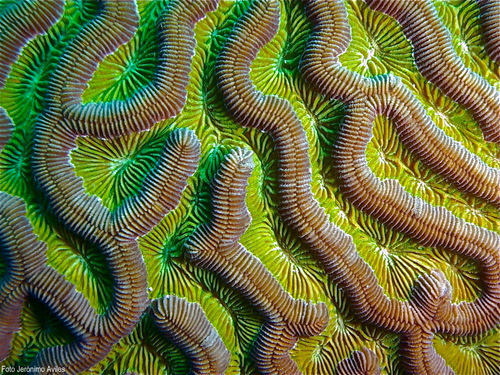
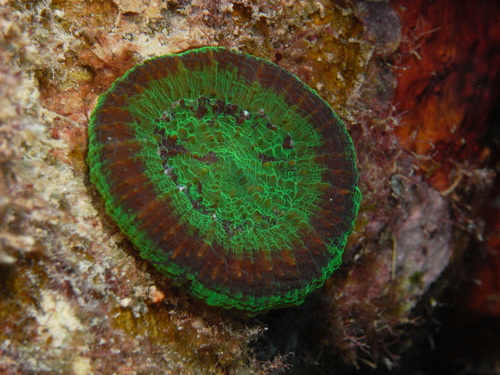
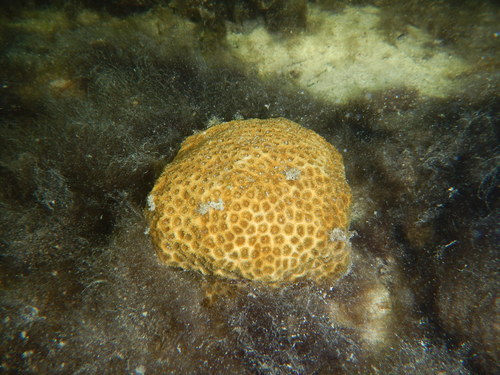
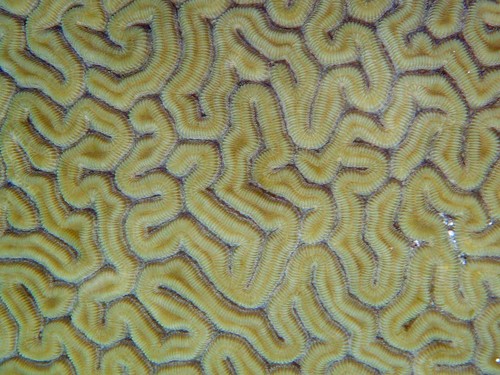
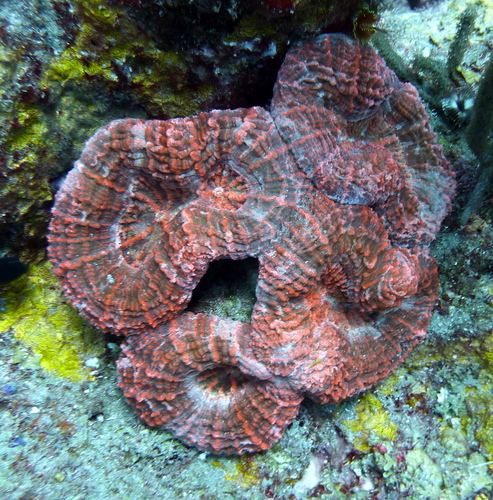
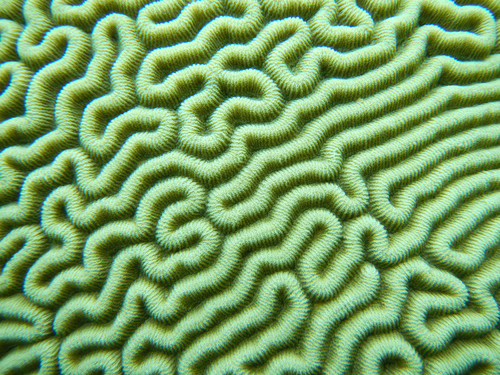
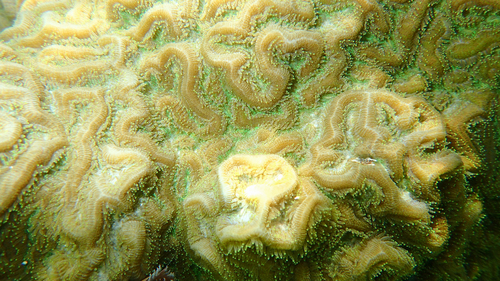
Pseudodiploria clivosa, commonly known as the knobby brain coral, is a massive reef-building coral. It typically forms hemispherical domes, though it can also grow into plates or encrust the seabed, especially in areas with high wave action. This species can reach a diameter of around 1.3 metres (4 ft 3 in). The surface of its dome usually has a number of bulges or knobs, but it is not easy to distinguish from the symmetrical brain coral, which typically has a smoother outline. Its surface is made up of sharply defined, convoluted ridges separated by valleys. Unlike the similar grooved brain coral (Diploria labyrinthiformis), knobby brain coral does not have a trough-like groove along the top of its ridges. The coral polyps of this species are arranged along the bottoms of the valleys between ridges, with each polyp housed in a small stony cup called a corallite. The sides of these corallites have thin, minute walls called septa, which occur in four different size cycles. Outside the corallites, septa extend as costae that connect adjacent corallites; in this species, these costae are discontinuous, which is another distinguishing feature. The colour of knobby brain coral is typically some shade of yellowish or greenish brown, which comes from symbiotic dinoflagellates called zooxanthellae living in the coral's tissues. Knobby brain coral is a common species found in southern Florida, the Caribbean Sea and the Bahamas. It grows on reefs, in seagrass (Thalassia testudinum) meadows, in lagoons, and sometimes on mangroves. It occurs at depths down to around 40 metres (130 ft), but is most common at depths less than 5 metres (16 ft). Fossilised remains of Pseudodiploria clivosa have been found alongside fossils of other massive corals (Pseudodiploria strigosa, Siderastrea siderea and Solenastrea bouroni) in Pleistocene-aged marine deposits in Río Grande de Manatí, Puerto Rico.