About Pseudocyphellaria carpoloma (Delise) Vain.
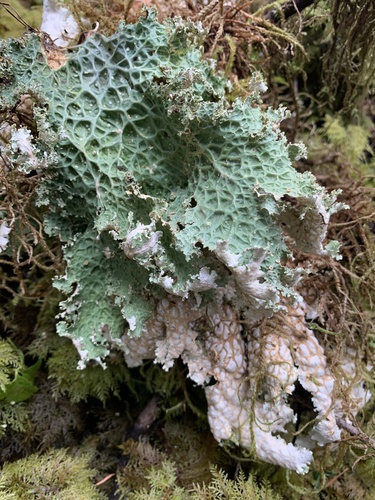
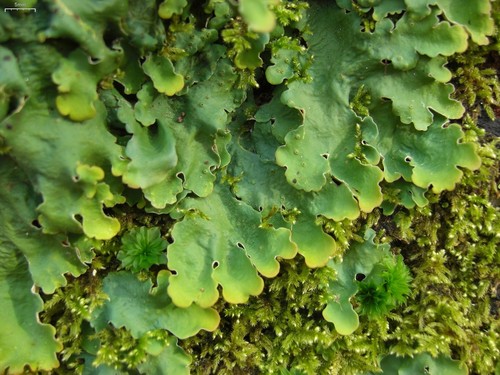
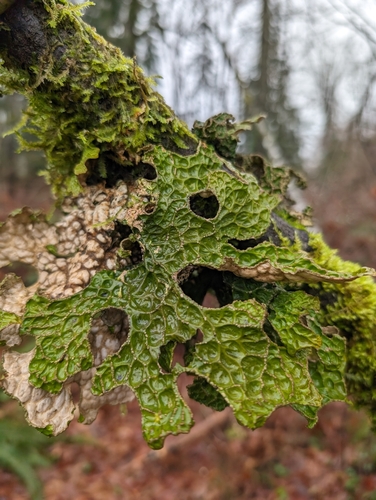
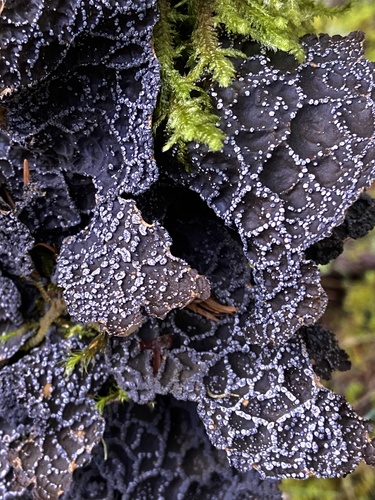
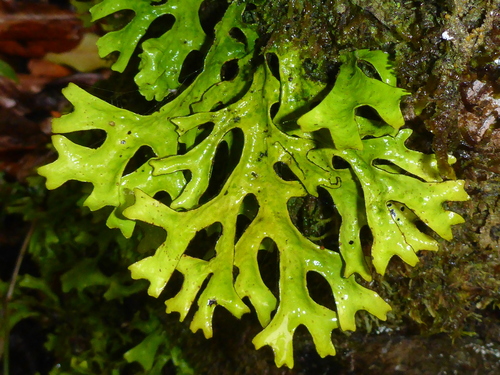
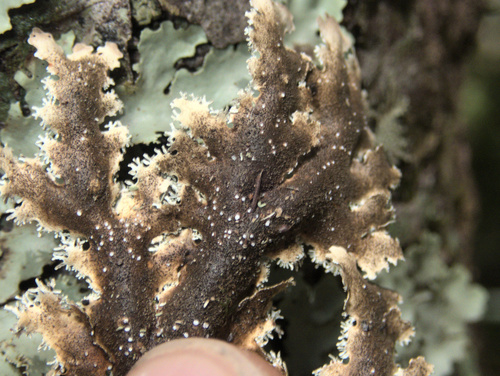
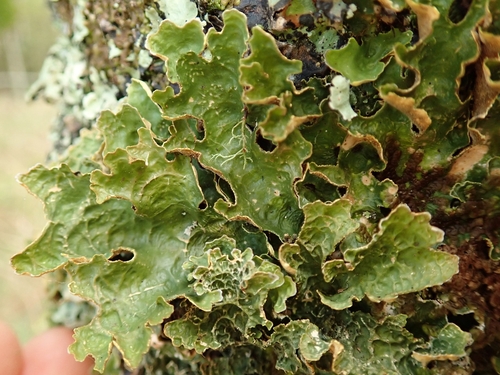
Pseudocyphellaria carpoloma (Delise) Vain. is a lichen with a thallus that measures 50 to 500 mm in diameter, and grows in large, sprawling, loosely tangled formations. Its lobes, which are 30–80 mm by 10–70 mm, have a distinct branching pattern that is subtly similar to dichotomy. The lobe margins are intact, and are subtly edged with yellow, wart-like structures called pseudocyphellae. Lobes show a range of colours depending on moisture level: vivid lettuce-green or olive-green when wet, and pale greyish-green when dry, with frequent brownish undertones, most notably towards lobe tips. The lobe surface is strongly faveolate, meaning it has pits and depressions that give it a dimpled appearance. This species does not produce isidia, phyllidia, maculae, or soredia – the asexual reproductive propagules found in some other species of the same genus. Pseudocyphellaria carpoloma has a white inner medulla layer, and its photosynthetic partner (photobiont) is the green alga Chlorella sphaerica. The lower surface of the thallus ranges from pale yellow at the margin to buff, brownish or dark red-brown in the central region. This lower surface has a distinct rim, with a silky, blistered (bullate) texture that becomes slightly hairy toward the center. The pseudocyphellae on the lower surface are less than 0.1 mm in diameter, scattered, wart-like, and grow on the lichen's ridges. Minute asexual reproductive structures called pycnidia are scattered across the upper surface, appearing as small dome-shaped swellings. Each pycnidium has a tiny red-brown or black apical pore surrounded by a pale zone. The fruiting bodies (apothecia) of Pseudocyphellaria carpoloma grow along lobe margins. They have a matte disc that is pale to dark red-brown when wet, and turns black when dry. The outer rim of the apothecium, called the exciple, is pale pink or whitish and has a rough texture. The spore-producing asci are cylindrical to club-shaped (clavate), and measure 70–85 by 12–16 μm. The ascospores are grey-brown, oval-ellipsoid, and have a thickened central partition called a septum. When spores mature, the septum divides to form three sections. Fully mature ascospores typically measure 22–25 by 7–11 μm. In terms of habitat and distribution, Pseudocyphellaria carpoloma is found in New Zealand. It is most common in northern coastal forest, but also occurs on the west coast of the South Island, Stewart Island, and the Kermadec Islands. It has been recorded growing on the trunk of the endemic New Zealand palm Rhopalostylis sapida.