About Pseudocolus fusiformis (E.Fisch.) Lloyd
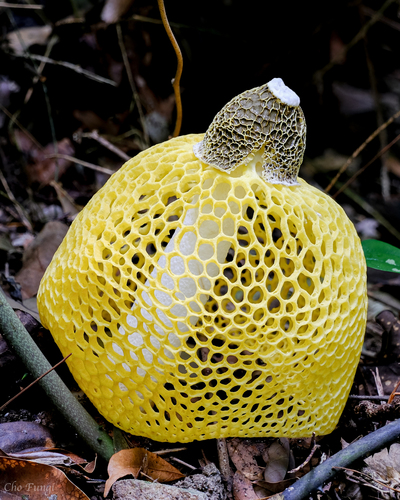
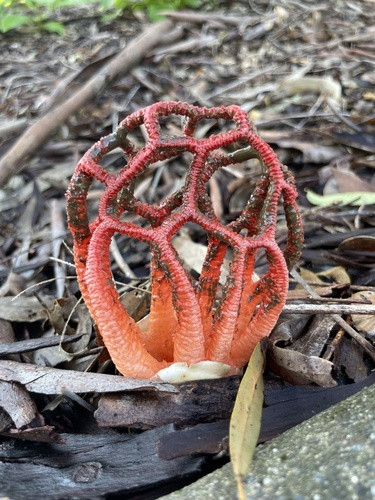
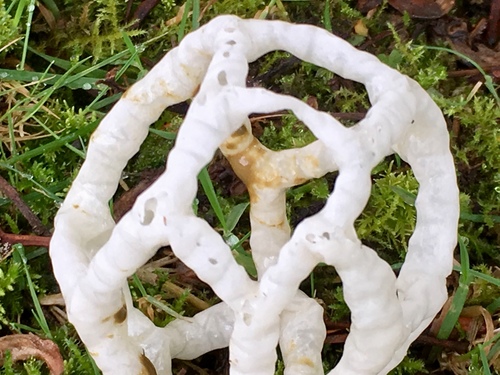
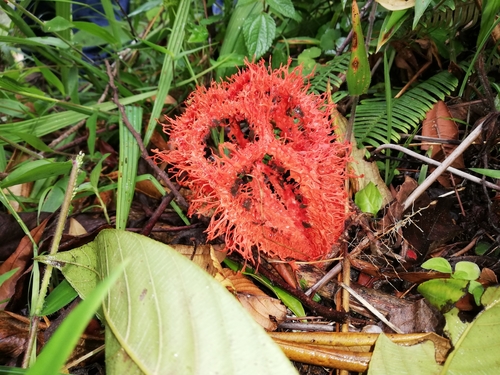
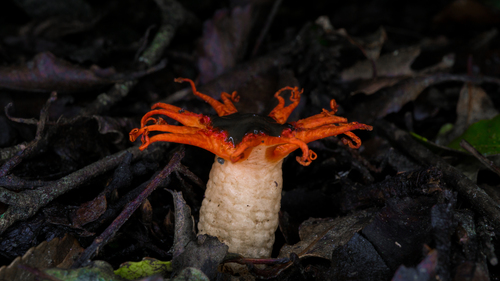
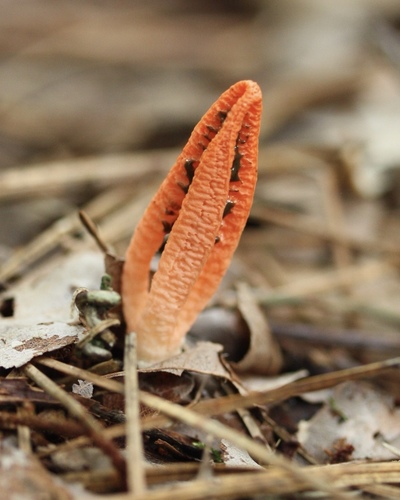
Immature fruiting bodies of Pseudocolus fusiformis resemble egg- or pear-shaped puffballs, and are colored grayish-brown to pale gray. They measure 0.5 to 2.5 cm (1⁄4 to 1 in) in diameter, and their top surface is broken into small distinct regions by cracks or crevices (a texture called areolate). As the fungus matures, the fruiting body cracks open and develops into a structure with a stalk, tapering arms, a protective basal volva, and a spore-containing mass called a gleba. Mature fruiting bodies typically reach 3 to 6 cm (1+1⁄4 to 2+1⁄4 in) in total height, and the arms are 2–5 times as long as the stipe (stalk). The stipe does not extend past the volva; it is hollow, thin-walled, chambered, wrinkled, and widens toward its upper end. The stipe is white or grayish-white, measures 1 to 3.5 cm (1⁄2 to 1+1⁄2 in) tall, and reaches 0.5 to 2.5 cm (1⁄4 to 1 in) thick at its widest diameter. Most mature fruiting bodies have 3 or 4 arms extending from the stipe, which average 3.6 cm (1+1⁄2 in) in length, with a range from 1 to 13 cm (1⁄2 to 5 in). The side of the arm that holds the gleba is wrinkled. The arms are joined at their top, shaped like a lance (lanceolate) with points toward the apex, and are orange in color. The internal structure of the arms is made of chambers: one large chamber toward the outside of the arm, and typically three smaller chambers on the inside. Gleba usually grows on the upper two-thirds of the inner surface of the arms, and is dark green and slimy. The gleba has a fetid odor, which one author compared to "fresh pig manure"; this odor attracts insects that help disperse the fungus's spores. The spores are elliptical or ovoid, smooth, and translucent (hyaline), with dimensions of 4.5–5.5 by 2–2.5 μm. The spore-bearing cells, called basidia, each have 6–8 attached sessile spores. For habitat and distribution, this species grows scattered or in groups on disturbed soil in coniferous or mixed forests. It also grows on wood chips used as mulch in gardens or for landscaping; Blanton has also reported a single, very large specimen growing alone in a garden. Pseudocolus fusiformis has been collected from locations worldwide, including Europe, Australia, Japan, Java, the Philippines, Reunion Island, the United States, and Turkey. It is thought to have been introduced from southeast Asia to North America, where it can be found from May to September. In the continental United States, it was first collected in Pittsburgh in 1915; since then it has been recorded in Alabama, Connecticut, Georgia, Louisiana, Florida, Massachusetts, Mississippi, New Jersey, New York, North Carolina, Rhode Island, Tennessee, and Virginia. It has also been found in Hawaii.