About Pseudocolaptes boissonneautii (Lafresnaye, 1840)
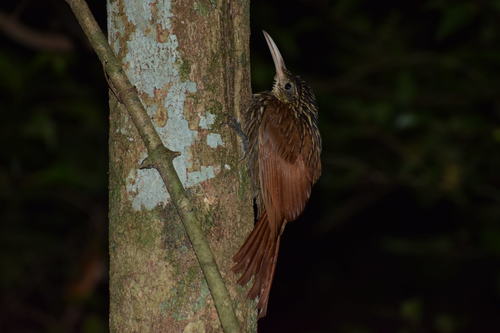
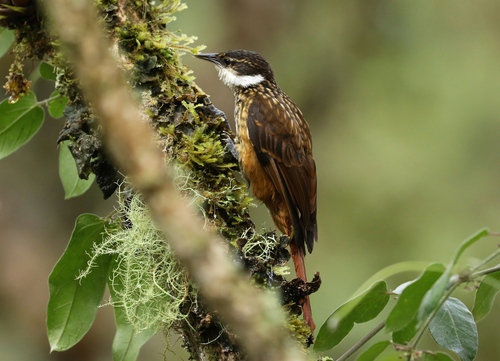
The streaked tuftedcheek, Pseudocolaptes boissonneautii, is 20 to 22 cm (7.9 to 8.7 in) long and weighs 37 to 62 g (1.3 to 2.2 oz). It is a rather large, strongly patterned ovenbird. The sexes share the same plumage pattern, but the female of most subspecies has a significantly longer bill than the male. The species' most distinctive feature is its namesake neck-side tuft of almost pure white feathers that can flare outward. Adults of the nominate subspecies P. b. boissonneautii have a buff-whitish supercilium, blackish brown lores and ear coverts, and white cheeks. Their crown is blackish brown with many thin buff streaks, while their hindneck and upper back share the same pattern but with wider pale buff streaks; the rest of their back is rufescent brown. Their rump and uppertail coverts are bright chestnut rufous, and their tail is bright rufous. Their wings are blackish brown, with pale rufous edges and tips on the coverts. Their secondaries have rufous edges at their base, and their tertials are mostly rufous. Their throat is white, their breast is pale golden buff with dark brown feather edges that create a scaled appearance, and the rest of their underparts are unmarked rufous that darkens toward the undertail coverts. Their iris is brown to dark brown, their maxilla is black, their mandible is grayish white to silvery with a blackish upper third, and their legs and feet are gray to slate. Juveniles have a much shorter bill than adults, an unmarked black crown, dense black scallop markings on the breast, and rich rufous belly and flanks. Other subspecies differ from the nominate and each other in the following ways: P. b. striaticeps has less breast scaling and duller underparts than the nominate; P. b. meridae has little or no black edges on neck and breast feathers; P. b. oberholseri has a darker crown and heavier black edges on neck and breast feathers than the nominate; P. b. intermedianus is similar to oberholseri but has heavier markings on its back; P. b. medianus has a yellowish tinge on the throat; P. b. auritus is similar to medianus but shows little difference in bill length between the sexes; P. b. carabayae is similar to auritus but is smaller, with a blacker back and a darker, more chestnut rump. The subspecies have the following distribution ranges: P. b. striaticeps is found in the Venezuelan Coastal Range; P. b. meridae is found in the Serranía del Perijá and the Andes along the Colombia/Venezuela border; P. b. boissonneautii occupies Colombia's Western and Southern Andes, and the southern portion of the Eastern Andes; P. b. oberholseri ranges from southern Colombia to southern Ecuador; P. b. intermedianus lives on the western slope of the Andes in northwestern Peru; P. b. medianus occurs in the Andes of northern Peru; P. b. auritus is found on the eastern slope of the Andes in central Peru; P. b. carabayae ranges along the eastern slope of the Andes from southern Peru south into central Bolivia. The streaked tuftedcheek inhabits the interior and edges of humid montane evergreen forest and elfin forest. Most of its population occurs between 1,700 and 3,200 m (5,600 to 10,500 ft) in elevation, but it can also be found as low as 1,450 m (4,800 ft) and as high as 3,500 m (11,500 ft).