About Pseudochorthippus montanus (Charpentier, 1825)
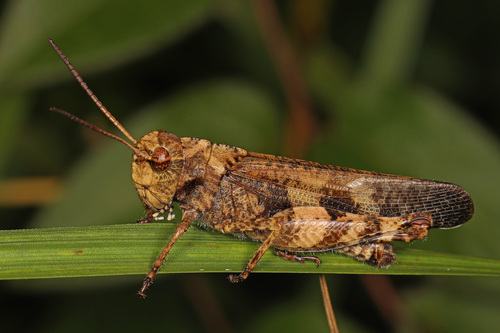
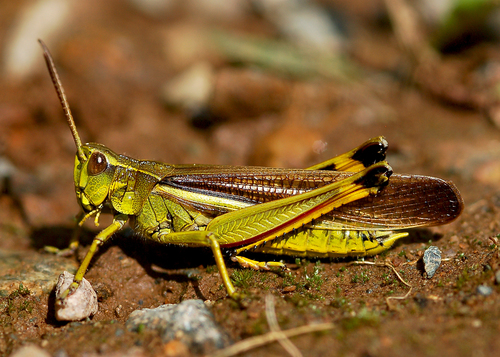
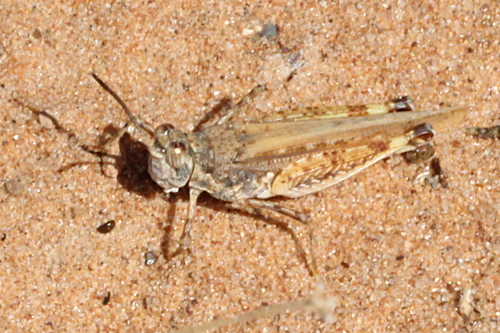
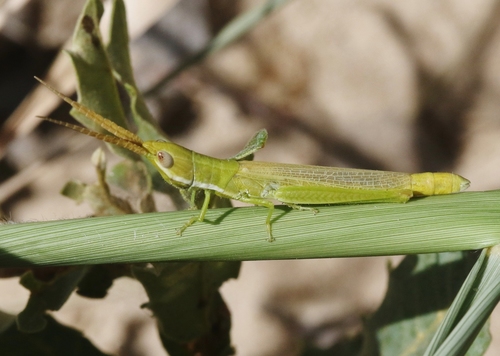
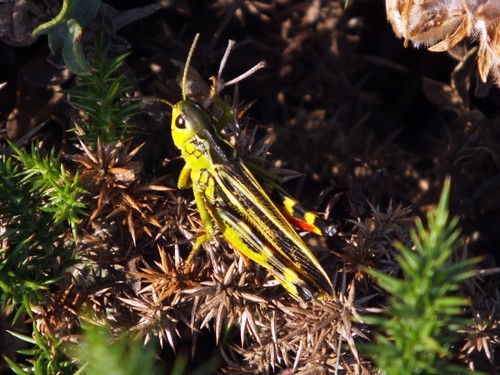
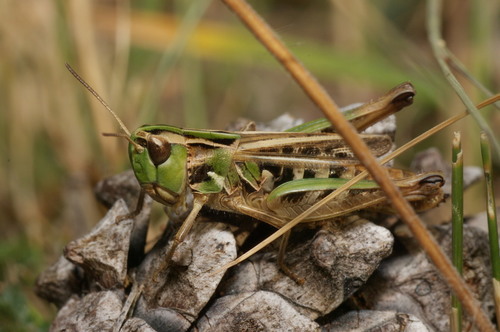
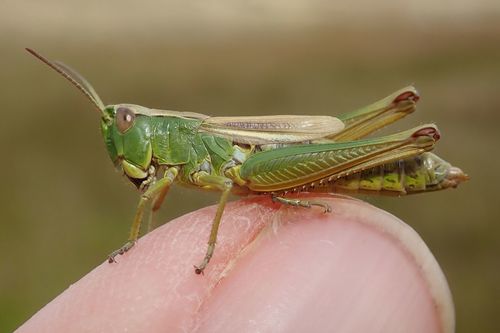
Pseudochorthippus montanus, commonly called the water-meadow grasshopper, has a body length of 12.9–16.0 mm for males and 17.0–22.0 mm for females. Like most slant-faced grasshoppers, its coloration is variable, with common forms including green morphs with brown backs, or entirely green bodies. This species, alongside the closely related common grasshopper, can be distinguished from other Chorthippus species by their dark knees, shortened wings, and slightly curved pronotal keels. It is challenging to tell Pseudochorthippus montanus apart from this closely related common grasshopper. Pseudochorthippus montanus has a slightly sturdier build, and its wing spot is positioned at least 2.5 mm from the wing tip, giving its forewings a more transparent appearance. In males, the hindwings (alae) extend just short of, or all the way to, the wing spot, while the forewings (tegmina) reach at least the mid-thigh, which is longer than the forewings of the common bush-cricket. Forewing length ranges from 9–11.8 mm for typical males, or 14.5–18 mm for macropterous males; for females, forewing length ranges from 8.7–12 mm, or 14–18 mm. When folded, the alae are always shorter than the elytra, measuring 5–7 mm in males and 5–6 mm in females. The pronotum measures 2.6–3.4 mm in males and 3.3–4.3 mm in females. The stridulatory pegs of Pseudochorthippus montanus average 137–139, compared to an average of around 94 in the common bush-cricket. Females of this species can be identified by their longer ovipositor valves and broader, more rounded wing tips. Both sexes of this species, and its close relative, can develop long-winged forms that are fully capable of flight. The water-meadow grasshopper’s range extends from Western Europe east to the Kamchatka Peninsula in Asia. In Europe, its northern range boundary covers northern France, the Benelux countries, and northern Scandinavia, reaching as far north as 68°N in Finland. Its southern range boundary runs from the Pyrenees through the French Massif Central, the southern Central Alps, the Apennines, the northern Balkans, Romania, Mongolia, and Manchuria. It is widespread across Central and Eastern Europe, even at lower elevations. In the Alps, it occurs between 370 and 2,480 meters, and prefers colline and montane zones. In Asia, its range stretches from southern Siberia to Verkhoyansk, the Altai Mountains, and Kamchatka. This species grows best in wet to moist habitats with low to medium-height vegetation, such as wet meadows, lake and river margins, and both high and low moors. It avoids tall vegetation including wet fallows, sedge beds, and reedbeds. It often occurs alongside Conocephalus fuscus (the long-winged conehead), Stethophyma grossum (the large marsh grasshopper), and Chorthippus dorsatus (the steppe grasshopper). It may overlap in range with the common bush-cricket in adjacent drier habitats, and occasionally hybridizes with that species. The behavior of the water-meadow grasshopper matches that of the common bush-cricket. It feeds on plant species including Molinia caerulea (purple moor-grass), Phragmites australis (common reed), Schoenus nigricans (black bog-rush), and various sedges. In laboratory conditions, it prefers grasses over sedges of the Carex genus. Adult water-meadow grasshoppers can be observed from June to November, and occasionally as early as late May. Adults emerge about one month later than they do in the common bush-cricket. In Central Europe, it is one of the latest-emerging short-horned grasshopper species, with peak adult populations occurring in early September.