About Pseudochelaria walsinghami Dietz, 1900
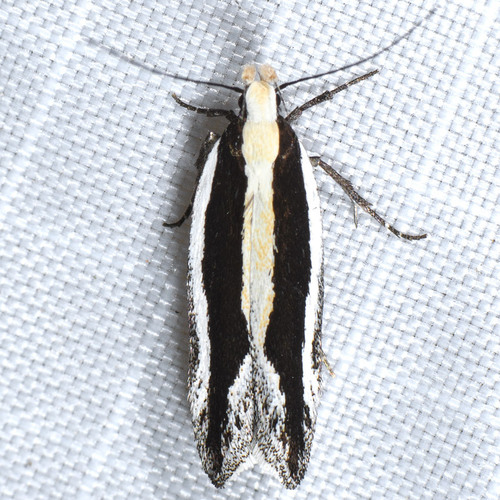
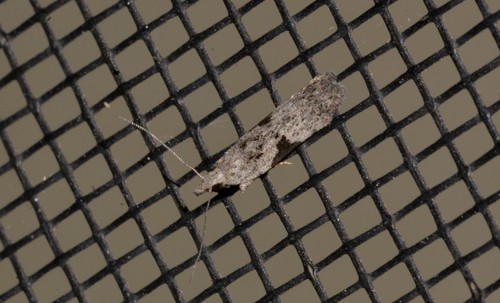
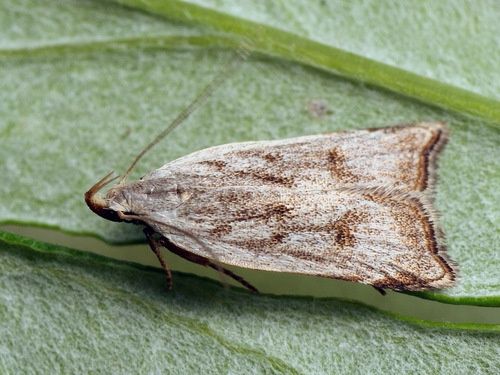
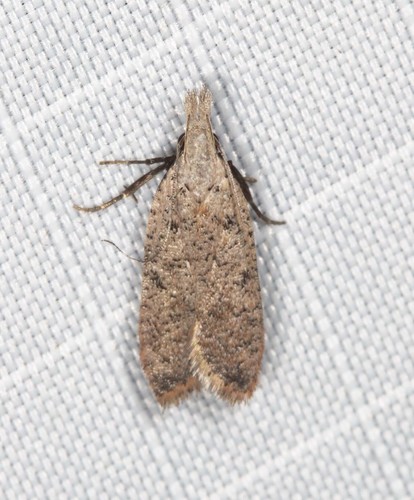
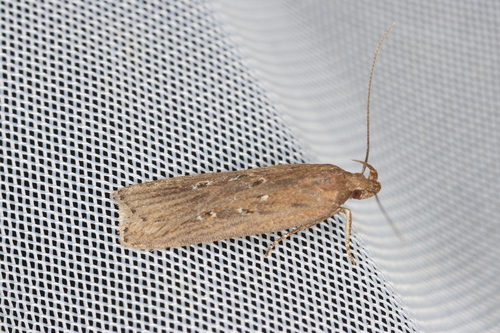
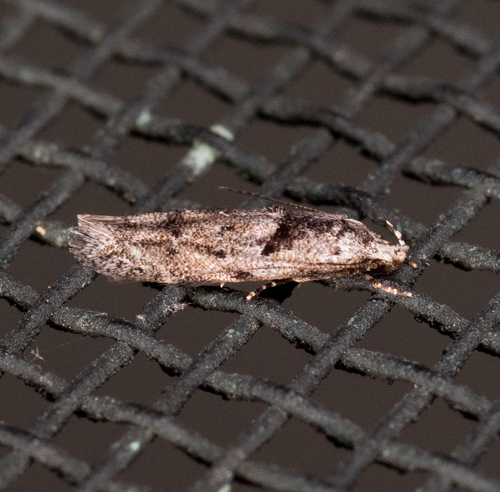
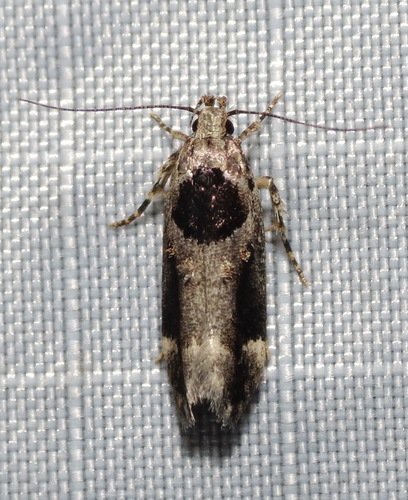
Pseudochelaria walsinghami is a moth species belonging to the family Gelechiidae. It was first formally described by Dietz in 1900. This species is native to North America, with confirmed records from the following US states: Alabama, Arizona, Arkansas, Florida, Illinois, Indiana, Kansas, Kentucky, Maine, Mississippi, Nebraska, North Carolina, Ohio, Pennsylvania, South Carolina, and Tennessee. The wingspan of adult individuals measures approximately 17 mm. The forewings are patterned with dark, rich brown. The basal area of the forewing is bound externally by a sharply defined oblique line, which is twice as far from the base at the dorsal margin as it is at the costal margin. This line does not cover the costal margin or the narrow area of adjacent wing surface. A distinct longitudinal stripe starts at the two-fifths position of the wing, extending through the center of the wing to the apex. This stripe is sharply defined along its dorsal margin, and becomes somewhat diffused with the dark shading on the costal half of the wing. A whitish fascia is located at the start of the apical cilia; it is interrupted by the longitudinal stripe and blends gradually into the dark shading of the apical portion of the wing. The costal segment of this fascia curves inward toward the apex, while the dorsal segment is straight and extends obliquely backward to the dorsal margin. The apical portion of the wing has dark lines that radiate out into the cilia. The median area of the forewing is washed with a brownish tone that carries a faint golden reflection, darkening toward the costal portion and more so toward the apical fascia. On the dorsal half of the forewing, there are two brown spots located at the two-fifths and three-fifths positions of the wing, respectively. The anterior of these two spots is surrounded by raised white scales. The hindwings are a pale fuscous color, and grow paler closer to the base. The larvae of this species feed on Rhus typhina. They live under a white web on the undersides of leaflets, and also along the plant petioles. The larvae are pale green with isolated hairs.