About Pseudocheilinus hexataenia (Bleeker, 1857)
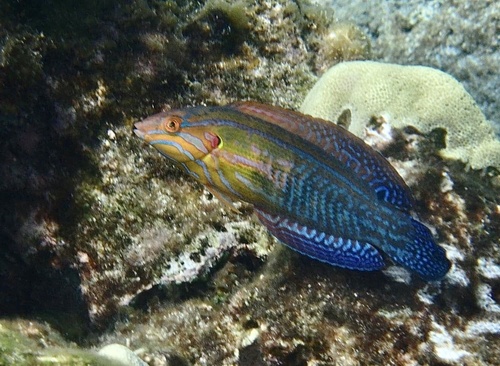
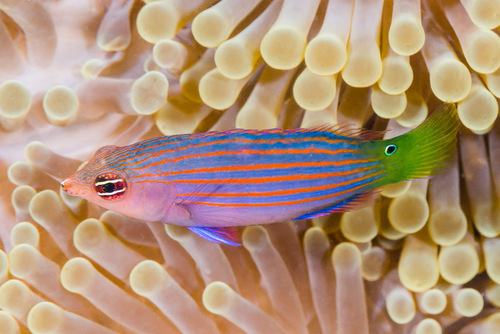
The six-line wrasse is a very small wrasse species that reaches a maximum total length of 10 centimetres (3.9 in). Its body is violet, marked with six orange stripes running along the flanks. It has a small eyespot on the dorsal section of the caudal fin base, a blue stripe along the base of the anal fin, a blue streak on the pelvic fin, and red eyes. This species was first formally described as Cheilinus hexataenia in 1857 by Dutch ichthyologist Pieter Bleeker (1819-1878), with its type locality recorded as Ambon in the Moluccas. When Bleeker established the genus Pseudocheilinus in 1862, he designated Cheilinus hexataenia as the genus's type species. The six-line wrasse's distribution ranges from the eastern coast of Africa, occurring from the Red Sea to South Africa, across the Indian Ocean and into the Western Pacific Ocean. In the Western Pacific, its range extends north to Japan, south to northern Australia, and east as far as Tuamotu. This wrasse is found among coral branches on seaward reefs, and also occurs in clear coastal waters, and in areas of dense coral growth on shallow reef crests or reef slopes. It has been recorded at depths up to around 20 metres (66 ft). It is a secretive, shy species that is typically found in small, loose groups that swim among coral branches for protection. It feeds mainly on small crustaceans. It has also been observed acting as a cleaner fish, removing ectoparasites including copepods and isopods from other fish. In the Izu Islands of Japan, spawning occurs just before sunset. Paired adults make a very quick dash toward the surface to spawn, and this dash speed lowers their risk of being preyed on by other fish. This is a diurnal species. At night, it shelters in cavities and creates a mucus cocoon to sleep in. It is thought that this cocoon helps protect it from nocturnal predators by masking the sleeping fish's scent.