About Pseudocheilinus evanidus Jordan & Evermann, 1903
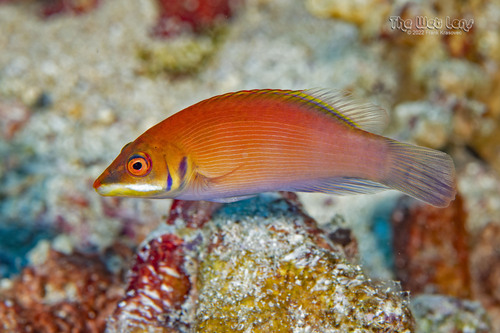
Pseudocheilinus evanidus, commonly called the striated wrasse, is a small species of wrasse. It has an overall reddish body marked with 24 fine longitudinal white lines, and may sometimes display 5 to 6 dark horizontal bars. It has a blue streak below the eye, and the gill cover has dark margins. This species can reach a total length of 9 cm (3.5 in). Males and females have similar coloration and patterns, but females typically have less intense color. The striated wrasse exhibits red fluorescence, which occurs on its bony scales and fin rays. Pseudocheilinus evanidus was first formally described in 1903 by David Starr Jordan and Barton Warren Evermann; its holotype was collected from Henshaw's pool near Hilo on Hawaii Island. The striated wrasse has a wide distribution across the Indian Ocean and Western Pacific Ocean, ranging from Africa to Hawaii. In the western Indian Ocean, its range extends from the Red Sea off Jordan to South Africa, and it has been recorded from the Seychelles, Aldabra, Réunion, Mozambique, and Pemba in Tanzania. In the Pacific Ocean, it is found as far north as the Izu Islands in Japan, south to the Marquesas Islands, and from Australia east to Hawaii. The striated wrasse is a solitary, secretive benthopelagic wrasse that inhabits the seaward slopes of reefs among patches of rubble or branching corals at depths of 6 to 40 metres (20–131 ft) or more, and it is uncommon at depths less than 20 metres (66 ft). It is a carnivorous species that feeds on small benthic invertebrates. It is an oviparous species that pairs during spawning, and breeding is thought to occur in the summer in Japan.