About Pseudoceros laingensis Newman & Cannon, 1998
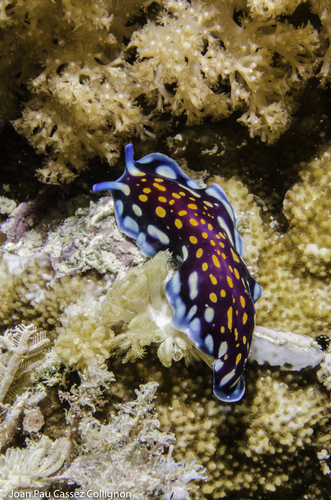
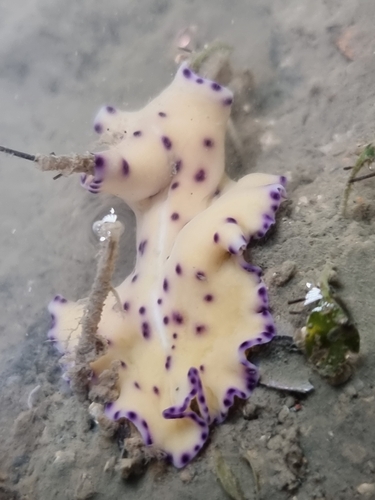
Pseudoceros laingensis Newman & Cannon, 1998 has a cream body background covered with widely spaced, scattered purple spots. Each purple spot is made of microdots, which are denser at the center of the spot and become finer toward the edges. Its ventral surface is uniformly cream. Pseudotentacles on this species are formed from simple folds of the anterior body margin, with small scattered pseudotentacular eyes located along this margin. It has a horseshoe-shaped cerebral cluster containing approximately 100 eyespots, and a large, wide pharynx constructed from elaborate folds. For its internal anatomy, the male reproductive system consists of a branched vas deferens, a rounded oblong seminal vesicle connected to a long coiled ejaculatory duct, and a large oval prostatic vesicle. A long, pointed, narrow cuticular stylet is held within a deep, voluminous antrum. The female reproductive system has a deep, wide female antrum and a narrow short vagina, which is surrounded by cement glands. This species is distributed across the Central Tropical Indo-Pacific, ranging from Indonesia to Papua New Guinea. It inhabits the external slope or top of coral reefs.