About Pseudoceros ferrugineus Hyman, 1959
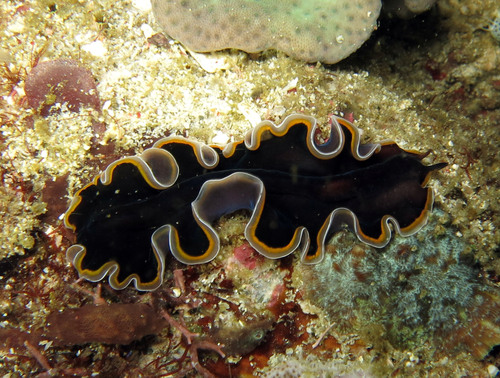
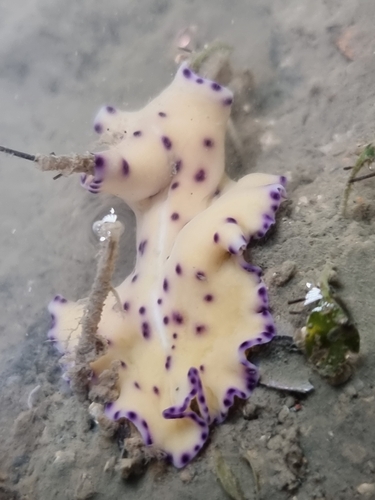
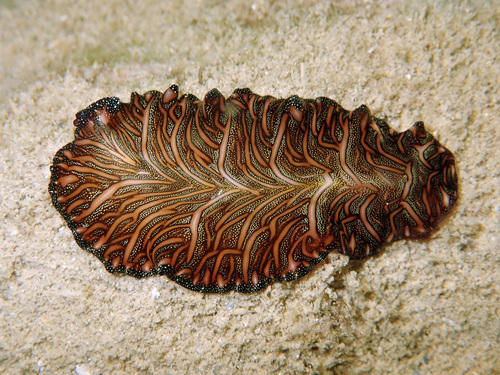
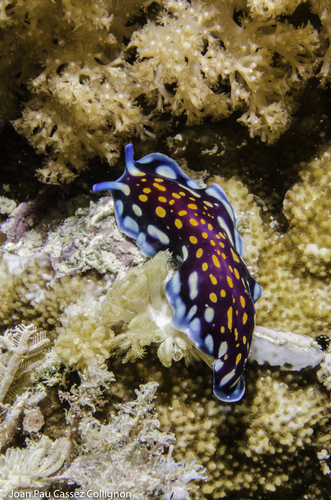
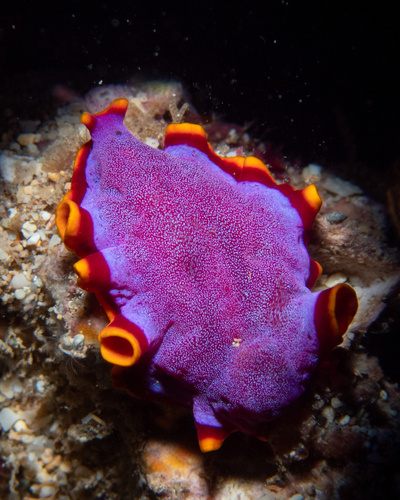
Pseudoceros ferrugineus Hyman, 1959 reaches 18 to 48 millimeters in length and has an enlarged oval body shape. Its common name comes from the fuchsia upper body surface, which is marked with small white dots and two non-dotted red and orange marginal bands, according to initial descriptions. This species has a large body with several deep marginal ruffles. For confirmed external anatomy, its base color is dark red, and the dorsal surface is covered in tightly packed small white dots that give the surface a bright pink appearance; there are no non-dotted red and orange marginal bands. Ventrally, the body is red, with color growing more intense toward the margin. Pseudotentacles are formed from simple broad folds of the anterior margin, and have numerous marginal eyes. The cerebral cluster is made up of a large number of eyespots. It has a small pharynx with elaborate folds. For internal anatomy, the male reproductive system is made up of a branched vas deferens, a long seminal vesicle connected to a short ejaculatory duct, a small two-chambered prostatic vesicle, a muscular prostatic duct, and a small stylet held in a shallow male antrum. The female reproductive system has a shallow antrum with a short vagina directed backwards. A thick, strong mass of cement gland surrounds the first portion of the vagina. This species is widespread across the tropical Indo-Pacific, ranging from the Indonesian Archipelagos to the Central Great Barrier Reef in Australia, Palau in Micronesia, the Philippines, and the Hawaiian Islands. It inhabits the external slope or top of coral reefs, found at depths between 1 and 15 meters.