About Pseudobulweria rostrata (Peale, 1848)
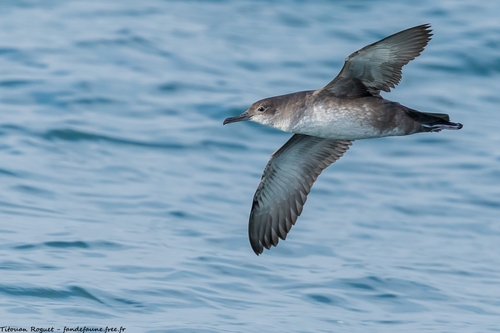
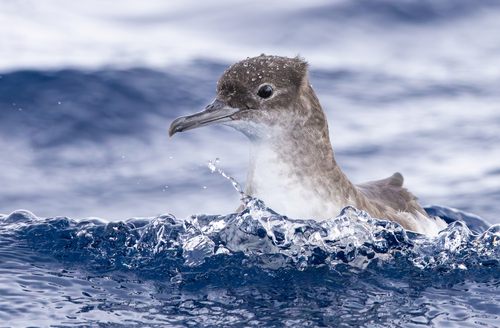
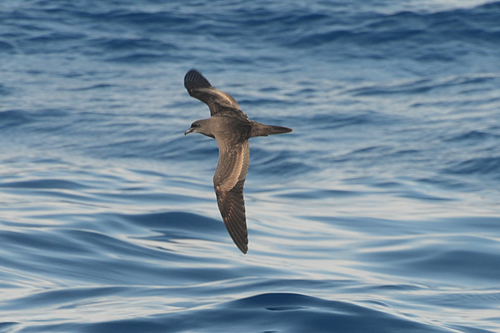
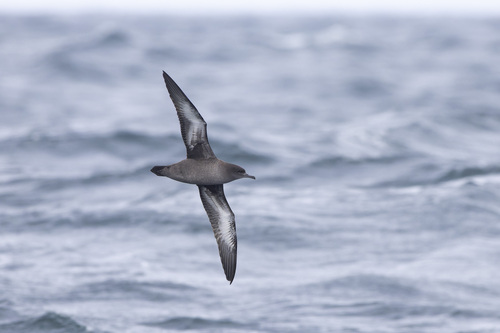
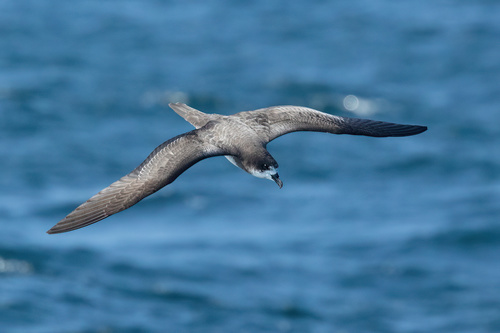
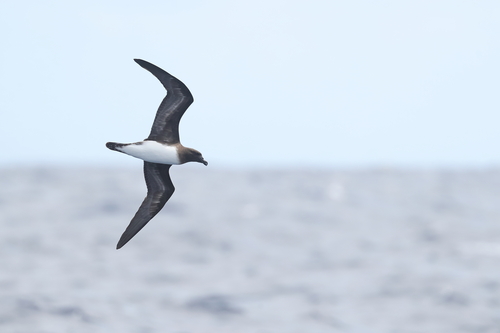
Adult Tahiti petrels (Pseudobulweria rostrata) weigh between 315 and 506 grams, have an average wingspan of 104.5 cm, and a total body length between 38 and 42 cm. This species can be identified by its wedge-shaped tail, long wings and neck, small head, black stout bulbous bill, dark brown eyes, and dark elongated body with a white abdomen. Adult plumage is mostly dark brown, with darker hoods and paler rumps; their underwings have a faint white line along the middle, and slightly paler flight feathers. Juvenile plumage matches that of adults, and females generally have smaller body measurements than males. At long range, Tahiti petrels can be difficult to distinguish from other petrels that share their geographic range. The most consistent key difference is that Tahiti petrels have narrower wings that are held fully perpendicular to the body and straight in flight, a posture that more closely resembles an albatross. By contrast, the similar but smaller Phoenix petrel (Pterodroma alba) flies with wings held more forward and bent. At closer range, Tahiti petrels can be told apart from Phoenix petrels because Phoenix petrels have a larger bill, no white line on the underwings, and a paler tail. The Atlantic petrel (Pterodroma incerta) is sometimes confused with the Tahiti petrel because it also has a white abdomen, but Atlantic petrels can be identified by their brown undertail, dark eye patch, and plain underwings. Despite its common name, the Tahiti petrel occurs across the Pacific Ocean. Its two recognized subspecies breed in different regions of the ocean. P. r. rostrata is confirmed to breed in American Samoa, the Gambier Islands, the Marquesas Islands, and the Society Islands, and may potentially also breed on Rarotonga in the Cook Islands. P. r. trouessarti is confirmed to breed in New Caledonia and Vanuatu. During the non-breeding season, the species is found in Australia, Guam, and the Federated States of Micronesia. Vagrant individuals have been recorded across South America, Central America, Asia, and Oceania, specifically in Chile, Colombia, Costa Rica, Ecuador, El Salvador, French Southern Territories, Guatemala, Indonesia, Japan, Kiribati, the Marshall Islands, Nauru, Nicaragua, Niue, Norfolk Island, the Northern Mariana Islands, Palau, Panama, Papua New Guinea, Peru, the Philippines, Pitcairn, Samoa, Tokelau, Tonga, Tuvalu, United States Minor Outlying Islands, and Wallis and Futuna. Tahiti petrels require both terrestrial and marine habitats; they occur in both shallow and oceanic marine habitats, as well as shrubland and forest terrestrial habitats. For marine habitats, they prefer water with surface temperatures higher than 25°C, so El Niño events may affect their abundance in East Pacific waters. When nesting, this species lays eggs at high altitudes in mountains or forests, which explains its preference for volcanic islands as breeding sites. While Tahiti petrels can breed year-round, there is a peak of egg-laying between March and July, and most newly fledged petrels are ready to fly between July and September. Overall, the breeding season generally falls within the March to October window. In New Caledonia, P. r. trouessarti nests in crevices and burrows at elevations up to 500 m above sea level. In other regions, the species may nest at elevations as high as 1,900 m. Overall, breeding biology information for the entire Pseudobulweria genus is limited, with no data currently collected on incubation or chick-rearing for this species.