About Pseudobiceros hancockanus (Collingwood, 1876)
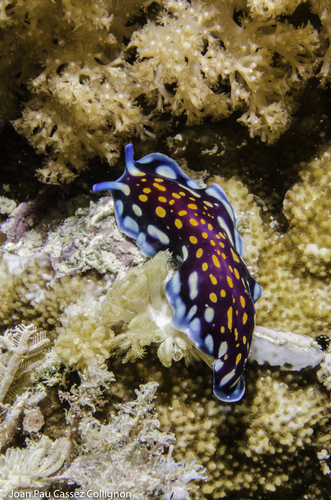
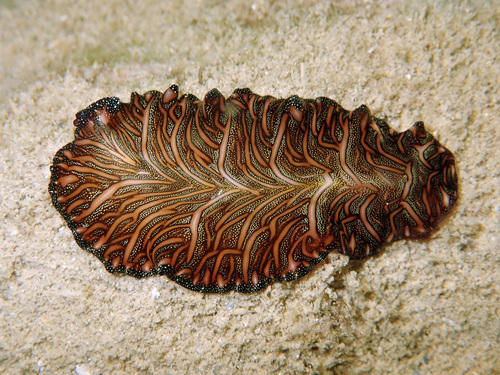
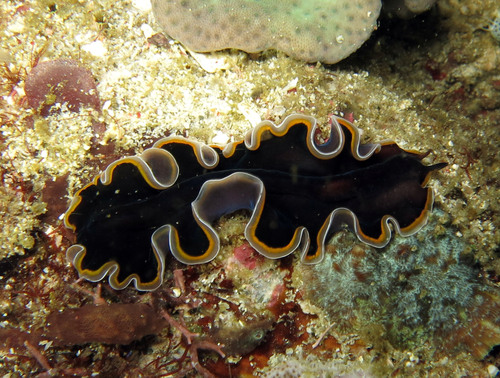
According to the Baensch Marine Atlas, Pseudobiceros hancockanus has an intense blue to black body with white and orange peripheral bands and a purple fringe. Its two short cephalic antennae are easy to overlook, as they match the body's color. The underside of this species is purple with a medial line. P. hancockanus looks very similar to Pseudobiceros uniarborensis, but their body margins differ: P. uniarborensis has a translucent gray margin with only an outer white line, while the margin of P. hancockanus is pure bright white. This species can reach a maximum length of 14 cm (5.5 inches). Pseudobiceros hancockanus inhabits warm seas, and is sometimes found on coral reefs, and other times among coral fragments or stones. It has been observed in regions near Indonesia, Fiji, and Kenya. Like other species in the genus Pseudobiceros, P. hancockanus is hermaphroditic: every individual can function as either a male or a female. When two of these worms mate, they engage in penis fencing. Each worm attempts to inject sperm into the other using one of its two stubby penises, while also trying to avoid being inseminated itself. Two explanations have been proposed for this behavior. The first notes that taking on the female role requires greater reproductive investment for the resulting fertilized eggs. The second suggests the duel gives a mating advantage to the stronger partner, so the loser (which becomes the female) gains the benefit of producing offspring with superior genes compared to its own.