About Pseudobatos productus (Ayres, 1854)
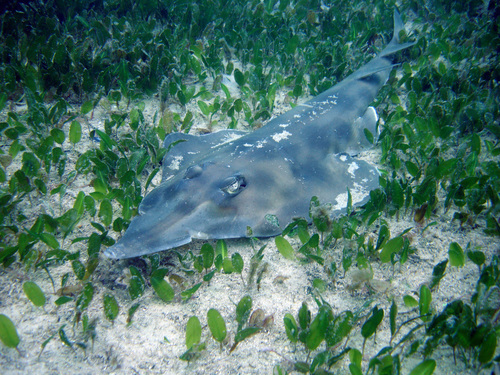
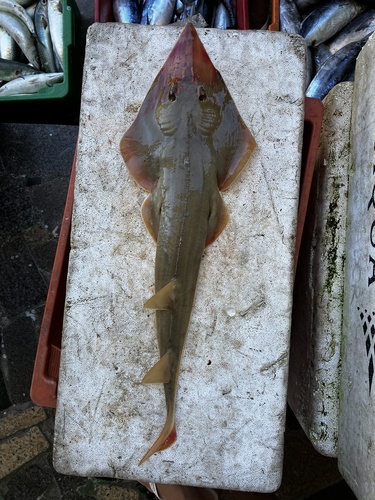
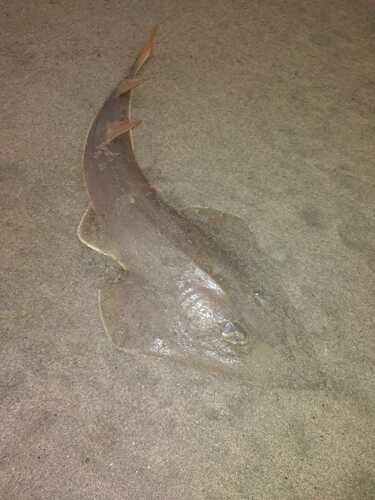
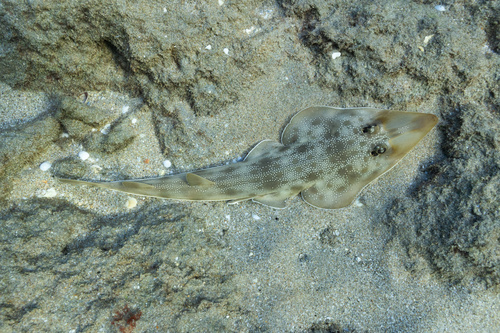
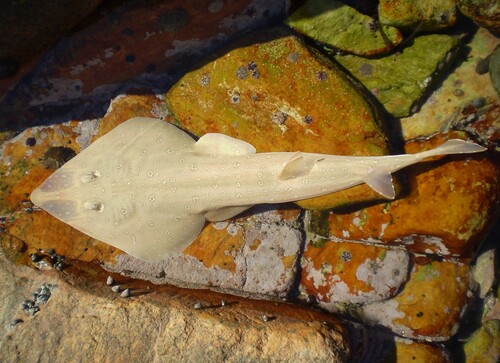
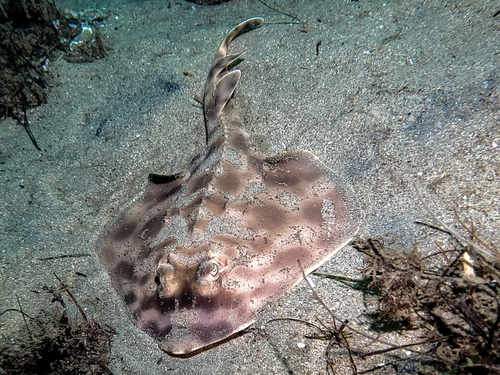
Pseudobatos productus, commonly called the shovelnose guitarfish, has coloration ranging from olive to sandy brown, which helps it camouflage in sand. Key identifying features of this species include a depressed body shape with a dorsoventrally flattened opaque snout, no gap between the pectoral and pelvic fins, protruding eyes, and two dorsal fins positioned close to the posterior end of the body near the caudal fin. Shovelnose guitarfish have between 102 and 112 small, round teeth.
Females reach sexual maturity at an estimated 8 years of age, while males reach sexual maturity at 7 years. This species displays sexual dimorphism, with females generally growing larger than males. At sexual maturity, males measure 90–100 cm (35–39 in) long, while females measure around 99 cm (39 in). The average size of shovelnose guitarfish is not well understood, as many studies have recorded fluctuations in the maximum total length individuals can reach. This ray can live up to 11 years. Fully grown males reach around 120 cm (47 in), and fully grown females reach 137 cm (54 in).
Shovelnose guitarfish may be confused with other similar batoids: the Atlantic guitarfish (Rhinobatos lentiginosus) and the bowmouth guitarfish (Rhina ancylostoma), but these species are found in different geographic regions. The Atlantic guitarfish shares similar anatomy with the shovelnose guitarfish but is shorter, with a maximum length of about 63.5 cm (about 2.08 ft), and lives in the Atlantic Ocean. The bowmouth guitarfish inhabits waters of the Indo-West Pacific, has a more rounded snout than the shovelnose guitarfish, and has larger dorsal fins; this species can reach lengths up to around 295 cm (about 9.68 ft).
Shovelnose guitarfish have spiracles located behind their eyes, which they use to pump water over their gills to absorb oxygen. Because their gills are located on the underside of their body, this adaptation allows them to continue breathing while resting on the seafloor. Like other fish, P. productus has a lateral line made up of a series of sensors that detect changes in water pressure and movement. Additionally, this ray has sensory structures called ampullae of Lorenzini under its nose and mouth, which allow it to detect low levels of electrical currents to alert it to potential food sources. The visual system of the shovelnose guitarfish is more extensive and developed than that of other Elasmobranchii, with multiple large projections connecting to the brain. Almost the entire dorsal and ventral hypothalamus is connected to the visual system, but the visual system still maintains a similar lack of differentiation as seen in sharks.
Pseudobatos productus inhabits shallow estuaries and bays of the Mexican Pacific, with a range extending from San Francisco, California to Guerrero, Mexico. It is also widely distributed across the Gulf of California. Research indicates that La Jolla, California is the preferred resident habitat for adult shovelnose guitarfish. Members of this species are not commonly found in open water, and typically stay in coastal ecosystems including bays, estuaries, and seagrass beds at depths of less than 40 feet. While there have been sightings of shovelnose guitarfish at depths as great as 91 meters, this is uncommon for the species. Females migrate to southern California and Baja in spring to spawn, and give birth in early summer. Males join them to mate shortly after, and both sexes leave the area together.
Studies of shovelnose guitarfish in the Gulf of California and the Pacific coast of Baja California have recorded morphometric variations among populations. Morphological and genetic variations, found in the mitochondrial DNA of individuals from the Gulf of California, provide evidence that these populations are isolated from other shovelnose guitarfish populations. This species has magnetic particles in its vestibular receptors, and these particles are believed to be exogenous (external) in origin. The spatial arrangement of these magnetic particles may help increase the sensitivity of vestibular receptors to movements.
Shovelnose guitarfish is harvested for human consumption and sold in national markets fresh, dried, or as salted fillets. The most common cuts of meat used come from the trunk, tail, and loin, and mostly come from mature individuals. It is often marketed as "shark steak", and is usually served fried; it is also prepared in other dishes including fish cocktails and kebabs. In Santa Barbara, California, it is sold as fish and chips on local piers. Dried shovelnose guitarfish specimens of all sizes are also frequently sold in shell shops from central California down to Baja California.