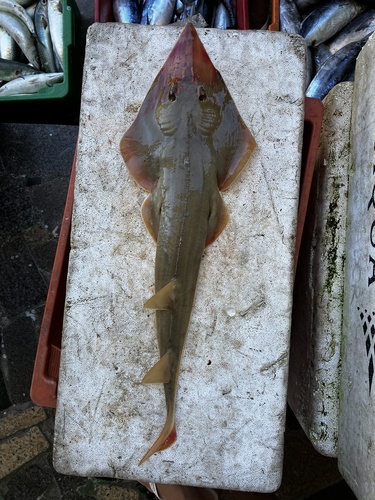
About Pseudobatos horkelii (Müller & Henle, 1841)
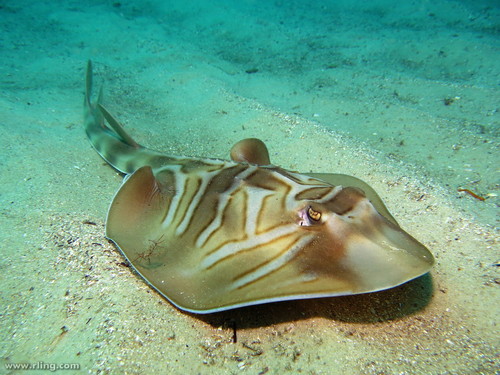
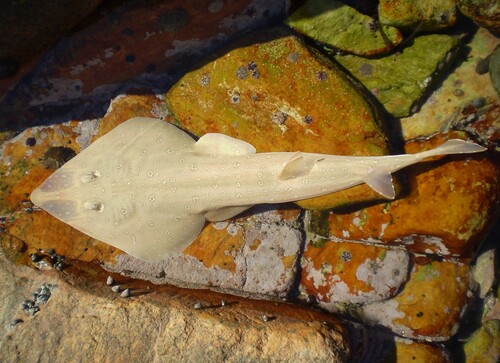
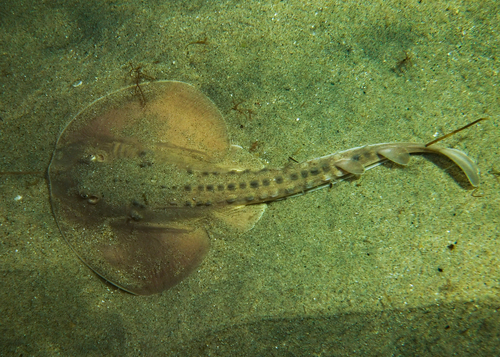
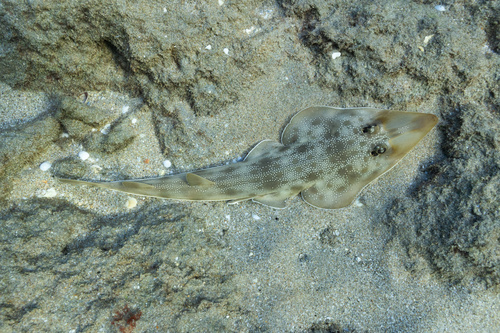
Pseudobatos horkelii, commonly known as the Brazilian guitarfish, can grow up to 138 cm (54 in) long, though the more typical adult size is around 60 cm (24 in). Its dorsal surface is a uniform olive-grey or brown. It has a dark patch on its snout, long nostrils, and a crown that is transversely flattened or slightly convex. This species is a low-fecundity viviparous fish. Mating occurs on the inner continental shelf in March; shortly after mating, adults disperse to outer areas of the shelf. Fertilized eggs are enclosed in a casing and remain dormant inside the female until she returns to the warm, shallow waters of the inner continental shelf in November. Young develop inside the female: they initially get nourishment from their yolk sacs, and later from maternal uterine secretions. They grow from roughly 1 cm (0.4 in) long in December to around 29 cm (11 in) long by February, when they are born. Females reach maturity at about 4 years of age. Litter sizes range from 4 to 12, and larger females produce larger litters. The inner continental shelf serves as an important nursery area for young Brazilian guitarfish. In this area, both females and juveniles are especially vulnerable to capture by pair-trawling and beach seine netting, and most captured individuals are pregnant females. Later in the year, adults disperse more widely across the inner shelf and are caught by otter-trawling.