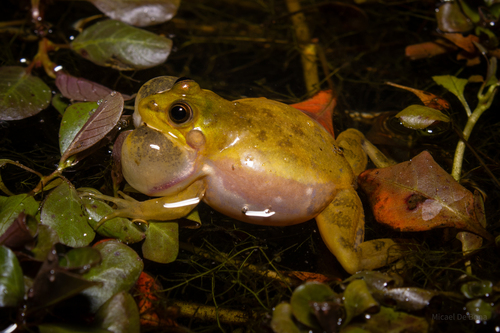
About Pseudis minuta Günther, 1858
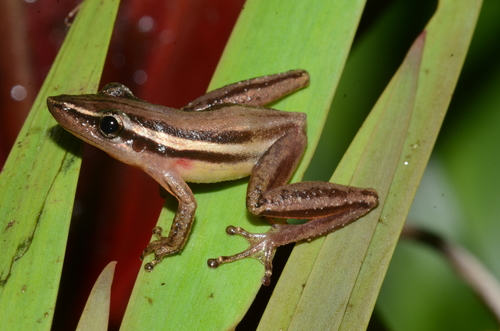
In snout–vent length, males of Pseudis minuta measure 24–39 mm (0.9–1.5 in), while females measure 39–51 mm (1.5–2.0 in). The species has a truncate snout when viewed from lateral profile, with slender fingers and relatively long, slender hind limbs. Its dorsal coloration is light green or brownish, and usually marked with small dark blotches; a distinct light middorsal band is present in some individuals. A light longitudinal stripe runs across most of the flank, and the thighs usually have three distinct stripes. Males of this species call mostly at night, while floating on the water surface and holding onto vegetation. They may also call from the leaves of water hyacinths, with their entire body out of water. Their call repertoire includes one type of advertisement call and two different aggressive calls. Male–male agonistic interactions use both advertisement and aggressive calls, and may also include wrestling. Pseudis minuta is a very common aquatic frog species. It inhabits ponds and still-water pools of slowly moving creeks at elevations below 500 m (1,600 ft) above sea level, and can also thrive in rice plantations. There are no known major threats to this species, as it even tolerates environments like rice plantations that receive heavy doses of pesticides. It is found in several protected areas.