About Pseudechis australis (Gray, 1842)
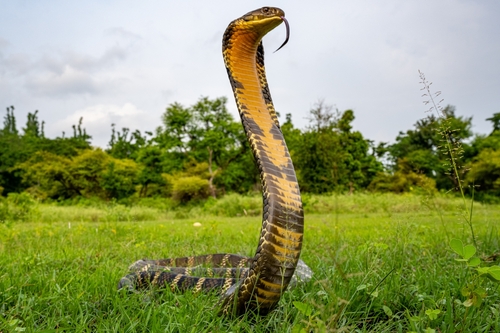
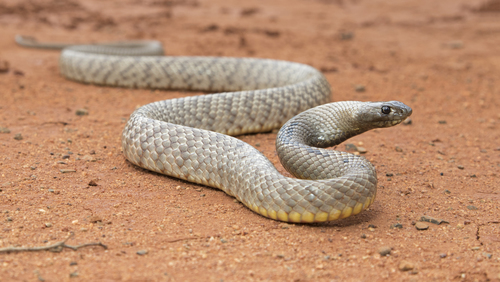
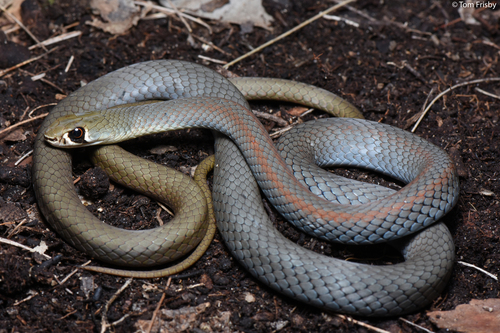
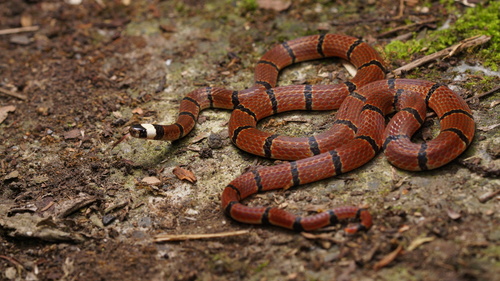
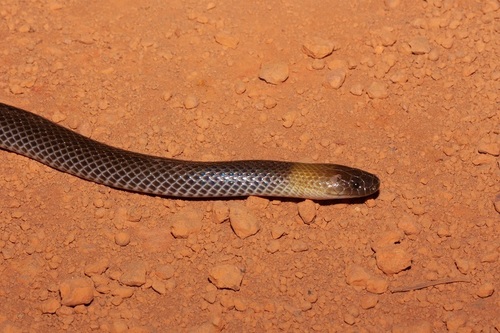
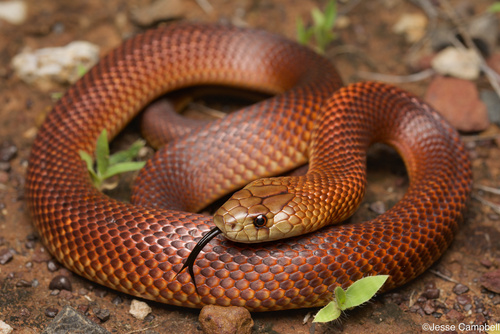
Pseudechis australis (Gray, 1842), commonly called the king brown snake, is Australia's largest venomous snake. Adults reach 2.0 to 2.5 m (6.6 to 8.2 ft) in length and weigh 3 to 6 kg (6.6 to 13.2 lb), with males roughly 20% larger than females. The longest confirmed individual on record measured 3.3 m (11 ft). This is a robust snake, with a head slightly wider than its body, prominent cheeks, small eyes with red-brown irises, and a dark tongue. A slight neck marks a clear division between the head and body. Scales on the upper body, flanks, and tail are two-toned: their base is pale or greenish yellow, and their tips are shades of tan or copper, or any shade of brown from pale to blackish towards the tail end. This two-tone patterning creates a reticulated appearance. The tail is often darker than the rest of the body, while the crown matches the body's colour. The belly is cream, white, or salmon, and may have orange markings. Upper body and side colouration varies across the species' range: northern Australian individuals are tan, Central Australian desert snakes have prominent white marks on each scale that create a distinct patterned look, and snakes from the southern parts of the range are darker, sometimes almost blackish. In Western Australia, all king brown snakes south of a line running through Jurien Bay, Badgingarra, New Norcia, and Quairading are noticeably darker in colour. King brown snakes are found in every Australian state except Victoria and Tasmania. The species has become rare or completely vanished from parts of coastal Queensland. The eastern boundary of its range extends from Gladstone in central Queensland, south through Gayndah, Dalby, and the Warrumbungles, then southwest to Condobolin and the area around Balranald, and finally across to Port Pirie in South Australia. The southwestern boundary runs from Ceduna in South Australia, west across the northern Nullarbor Plain to Kalgoorlie and Narrogin, ending on coastal plains north of Perth. This species is a habitat generalist that lives in woodlands, hummock grasslands, chenopod scrublands, and nearly bare gibber or sandy deserts. Within the arid to semi-arid portions of its range, it prefers moister areas such as watercourses. It is frequently seen in modified habitats including wheat fields, rubbish piles, and vacated buildings, and individuals sometimes become trapped in mine shafts and wellbores. Field research conducted near Alice Springs found that king brown snakes prefer areas with buffel grass (Cenchrus ciliaris), a widespread introduced weed in Central Australia, likely due to the dense year-round cover the grass provides. Mating season starts when male king brown snakes take part in wrestling combat, where each male tries to push the other over to win mating access to a female. Mating happens at different times across the range: early Southern Hemisphere spring in southwest Western Australia, mid-spring in the Eyre Peninsula, and during the wet season in northern Australia. The species is oviparous, with only one unconfirmed report of viviparity. Females produce a clutch of 4 to 19 eggs, averaging around 10 eggs per clutch. Larger, longer females produce larger clutches, and egg-laying generally occurs 39 to 45 days after mating. Eggs take approximately 70 to 100 days to hatch. Recorded incubation temperatures range between 22 and 32 °C (72 and 90 °F). On average, eggs measure 40.1 mm (1+5⁄8 in) long by 22.9 mm (7⁄8 in) wide, and weigh 13.1 g (0.46 oz) each. Newly hatched baby snakes average 22.6 cm (8+7⁄8 in) in length and weigh 9.4 g (0.33 oz). King brown snakes have been documented to live up to 25 years in captivity.