About Pseudanthias squamipinnis (Peters, 1855)
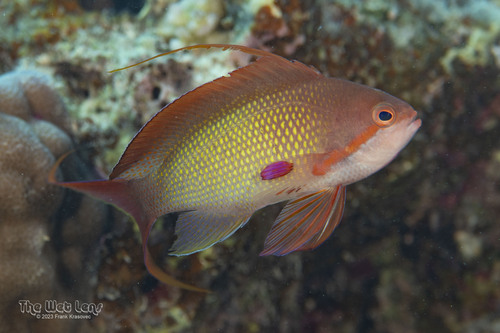
Pseudanthias squamipinnis, commonly called the sea goldie, exhibits strong sexual dimorphism. Females grow up to 7 cm (2.75 in) long, and are orange or gold in color with a violet streak below the eye. Males grow up to 15 cm (5.9 in) long, are fuchsia in color, have an elongated third ray on the dorsal fin, a red patch on the pectoral fin, and elongated margins on the tail. The midas blenny, Ecsenius midas, goes through a yellow coloration phase and acts as a social mimic of the sea goldie. The sea goldie feeds primarily on zooplankton. Like other anthias species, the sea goldie is a protogynous hermaphrodite. Males maintain a harem of five to 10 females; if the harem's male dies or leaves, the largest and most dominant female will undergo hormonal and physical changes to become the harem's new male. This change can take several weeks to months to complete. In the Red Sea, spawning takes place at sunset between December and February. The sea goldie is found in the western Indian Ocean (including the Red Sea), and in the Pacific Ocean as far east as Japan, the Great Barrier Reef, and southeast Australia. It is not found in the Persian Gulf, Hawaii, or Oman. This fish lives around coral outcrops in clear lagoons, patch reefs, and steep slopes down to a depth of 35 meters. It is often found alongside Chromis dimidiata, and frequently forms very large schools above the reef.