About Pseudacris triseriata (Wied-Neuwied, 1838)
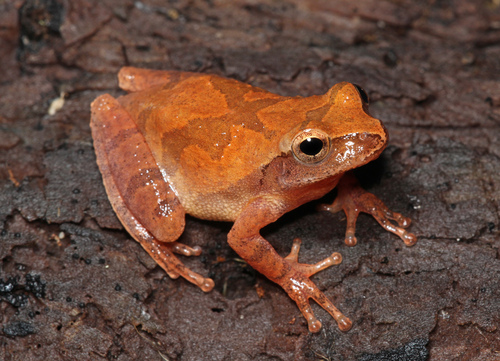
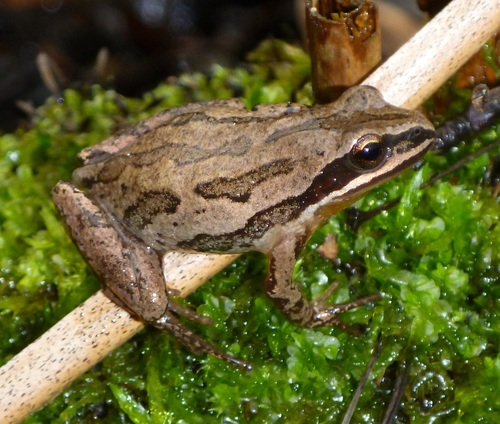
Western chorus frogs (scientific name: Pseudacris triseriata, first described by Wied-Neuwied in 1838) are small amphibians that grow to around 40 mm (1.6 inches) long. They have smooth skin, and can be colored greenish-grey, reddish, olive, or brown. Local color variation is common and does not indicate range-specific separate populations. Most individuals have three dark brown or grey stripes running along the entire dorsal (back) side; these stripes may be broken, reduced, or even absent in some specimens. The ventral (underside) of the frog is white or cream-colored, usually scattered with dark flecks. A single white stripe runs along the upper lip, while a thick dark stripe runs across the eye, extending from the snout along each side to the leg. Some individuals also have a dark triangular marking on the head. These frogs have small, round toes without adhesive pads, and very little webbing between toes. In most cases, males are smaller than females. Calling males can be distinguished by their yellow vocal sacs; when not calling, the sac appears as a dark, loose flap of skin under the throat. Tadpoles of the western chorus frog have gray or brown rounded bodies, clear tail fins marked with dark flecks. If observed closely, the intestinal coil can be seen through the skin on their belly, and their lips are black. This species has an extremely large distribution range, stretching from Canada down to the Gulf of Mexico, and from New Jersey west to central Arizona. They inhabit elevations from near sea level up to around 12,000 ft (3,700 m) above sea level, and can survive temperatures as low as –8 °C. Western chorus frogs can live in a wide variety of habitats. Permanent water bodies carry higher risk of predation for eggs and tadpoles, so these frogs mostly stay in ephemeral (temporary) freshwater areas, including marshes, river swamps, meadows, grassy pools, and other open areas in mountains and prairies. Western chorus frogs remain close to these temporary aquatic habitats, as these areas provide ideal sites for mating, breeding, and hibernation. Since these temporary areas often dry out completely, the frogs can occasionally be found in fallowed agricultural fields, damp woodlands, roadside ditches, and wooded swamps, though they are less common in these locations. Breeding timing varies across the western chorus frog's range. Most populations have a breeding season from March to May, with the highest activity in April. Breeding occurs earlier in the southern parts of the range, and timing varies across the entire distribution. The first sign of breeding is male choruses heard on sunny days; males call to attract females over a period ranging from several days to months. As the breeding season progresses, competing male choruses shift to calling in the evenings, and on cloudy or rainy days. The average lifespan of western chorus frogs is five years. After mating, a female can lay between 500 and 1500 eggs total in one breeding season. She lays one cluster at a time, with each cluster holding 20 to 300 eggs. The eggs form a loose gelatinous cluster, submerged underwater and attached to weeds or grasses along the edges of shallow ponds, flooded swales, roadside ditches, flooded fields, open areas, and swamps. Eggs hatch into tadpoles between 3 and 14 days after being laid. Water temperature is a limiting factor for the growth of eggs and tadpoles, as colder water slows or stops their growth. Tadpoles metamorphose into froglets 40 to 90 days after hatching. Western chorus frogs are quite adaptable and tolerant of human activity, but populations are declining in some regions. The IUCN Red List classifies this species as Least Concern, and it has no special status on the US Federal List. In Canada, the Great Lakes/St. Lawrence - Canadian Shield population of the western chorus frog is listed as Threatened under the Species at Risk Act (SARA), and the species is currently the subject of a compensation legal dispute between a landowner and the Government of Canada. The western chorus frog acts as an important indicator species. Deformities, reduced reproductive success, or morphological changes in larval or adult individuals can indicate environmental pollution or toxic substances (sometimes trematodes). Thus, the health of western chorus frog populations is valuable for assessing overall ecosystem health, and detecting leakage of pesticides, herbicides, or fertilizers from agricultural practices into the environment.