About Pseudacris regilla (Baird & Girard, 1852)
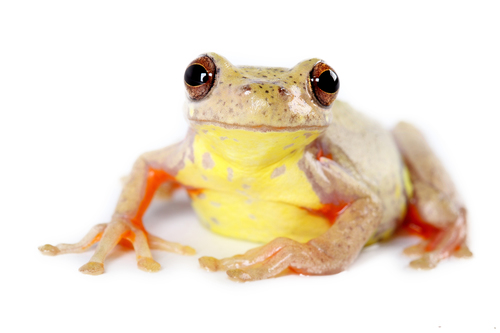
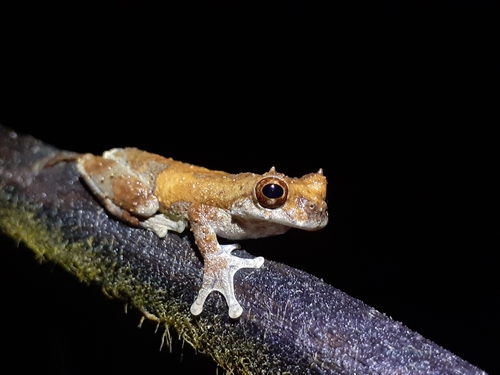
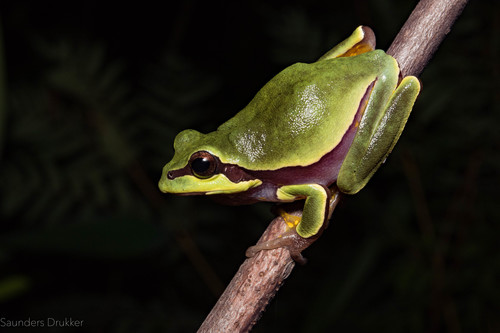
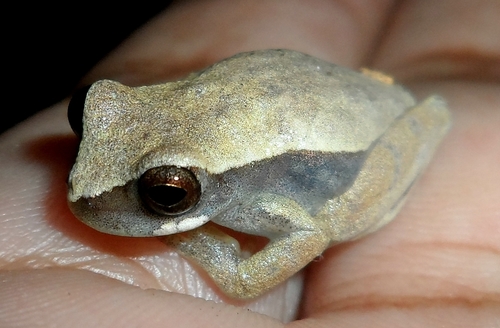
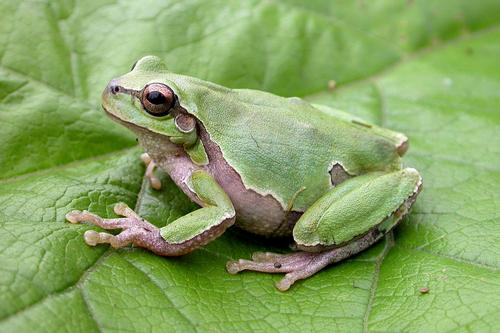
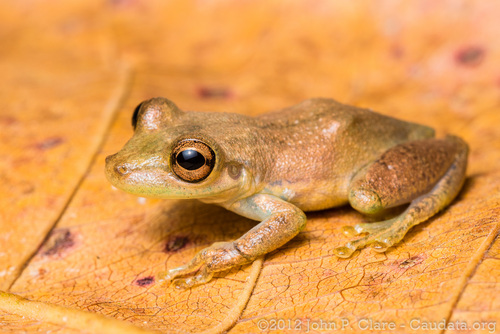
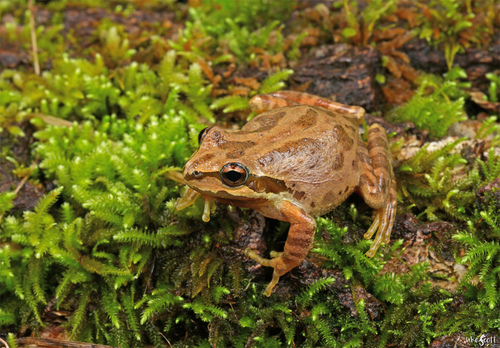
Pseudacris regilla, commonly known as the Pacific tree frog, reaches a maximum length of 2 inches from snout to urostyle. Males are typically smaller than females, and have a dark vocal sac on their throat that stretches when they call. Pacific tree frogs display a wide range of colors including green, tan, reddish, gray, brown, cream, and black; most individuals are a shade of green or brown, with pale or white bellies. They have dark, spotty markings on their backs and sides, and a distinctive identifying feature is a black or dark brown eye stripe that runs from the nose across the eye back to the shoulder. They can change color seasonally to better camouflage against their environments, and their skin is covered in small bumps. They have a slender build with long legs relative to their body size, and their long toes are only very slightly webbed. Each toe ends in a round, sticky toe pad that lets them climb and adhere to surfaces. Males also have a small, hard-to-see extra toe on their outer thumbs that is used solely for amplexus, and this species uses external fertilization.
Pacific tree frogs are common along the Pacific coast of Oregon and Washington, and can also be found in extreme northern California, British Columbia, Idaho, and Montana. A small introduced population has existed in a pond on Revillagigedo Island near Ketchikan, Alaska since the 1960s, when the species was intentionally brought to the area. They live in upland ponds, streams, and lakes, and sometimes live even farther from water; their habitat covers a wide range of climates and vegetation types, ranging from sea level up to high altitudes. They make their homes in riparian areas, woodlands, grasslands, chaparral, pasture land, and even urban areas including backyard ponds. The eggs of Pacific tree frogs may be eaten by rough-skinned newts and other amphibians.
Pacific tree frogs begin mating between early winter and early spring, and their breeding season is determined by local conditions across their wide geographic range. When breeding season arrives, males migrate to water and call in groups to attract females to the water to mate. Females lay their eggs in clumps of 10 to 90 eggs, most often attaching them to or placing them under vegetation and leaf litter in shallow, calm still water. If eggs survive, embryos hatch into tadpoles between 1 and 3 weeks after laying. Tadpoles feed on periphyton, filamentous algae, diatoms, and pollen on or in the water; they feed via suction, and use a beak-like structure to scrape food off vegetation surfaces.
This species attracts mates through group choral calling. Males call as loudly as possible to females, producing a croak loud enough to sound like it comes from multiple males, which can be heard by many females. Once a female approaches, the male stops calling and attempts amplexus. Breeding occurs at night near shallow water, typically after rainfall. Mating season usually runs from December to May, with variation based on multiple factors, and altitude often affects how long the breeding season lasts.
Metamorphosis typically occurs around 2 to 2.5 months after hatching, though some captive-raised tadpoles delay metamorphosis, completing transformation up to 5 months after hatching. Delayed metamorphs have a lower survival rate, and the evolutionary benefit of this delay is not yet clear; it may be linked to how common wildfire is in the species' natural ecosystems. In the final stage of transformation, when tadpoles have four limbs and still have a tail, they stop eating briefly as their mouth widens and their digestive system adjusts from a herbivorous to a carnivorous diet. Pacific tree frogs mature quickly, and usually mate in the breeding season immediately after they complete metamorphosis. They can live up to 8 years when kept in captivity.
Pacific tree frogs are mostly nocturnal, though they may occasionally move and call during the day. They spend much of their time hiding under rotten logs, rocks, long grasses, and leaf litter, where they are very hard to spot unless they move. Their predators include snakes, raccoons, herons, egrets, and other small mammals and reptiles. When hunting, their toe pads allow them to climb vegetation and other surfaces to ambush prey. Their diet consists mostly of spiders, beetles, flies, ants, and other insects and arthropods; they can eat insects nearly as large as their own body, expanding their body slightly to accommodate these large meals. When they detect nearby potential prey, they often twitch a toe to draw the prey within striking distance of their tongue.
Pacific tree frogs produce several distinct call types: the male advertisement call, commonly described as "ribbit" or "crek-ek"; an encounter trill call; and a "dry land call", which is a long cre-ee-ee-eeek that can be heard any time of year except during the coldest and driest periods. The crek-ek call is very loud and can be heard from far away, and Pacific tree frogs are the most commonly heard frog species across much of the West Coast of the United States.