About Pseudacris brachyphona (Cope, 1889)
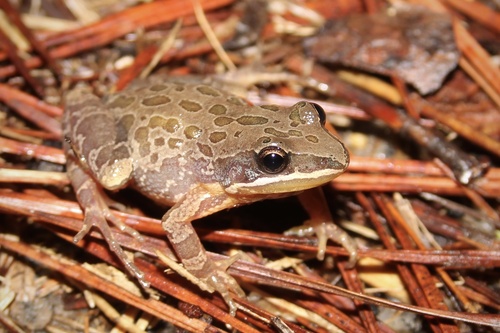
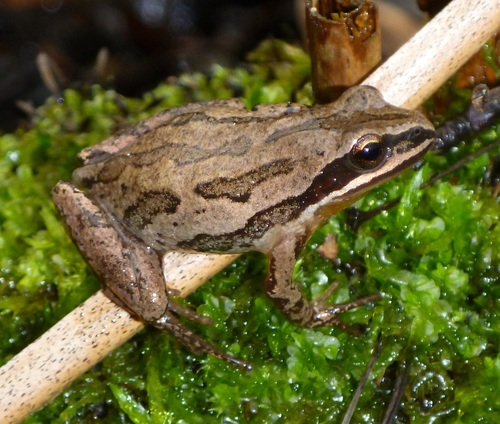
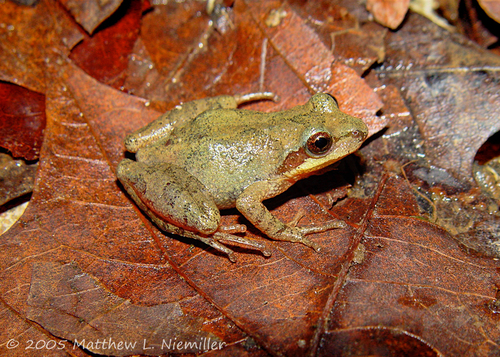
The Appalachian mountain chorus frog, scientifically named Pseudacris brachyphona (Cope, 1889), is a small frog of intermediate size within the genus Pseudacris. Its coloration spans different shades of grey and brown, including sorghum brown, deep brownish-drab, and mars brown. It has a stocky body and a broad head; the structure and size of the species are very similar to that of the pine woods tree frog, Dryophytes femoralis. Adult P. brachyphona reach a head-and-body length of 1.0 to 1.4 inches (25 to 36 mm). Males typically measure between 24 and 32 millimetres (0.94 and 1.26 inches), while females measure between 27 and 34 millimetres (1.1 and 1.3 inches). Distinct markings of the species include a triangular patch between the eyes and a white line along the upper lip; breeding males have a dark-colored throat. This frog is native to the hillsides of southwestern Pennsylvania, western Maryland, southeastern Ohio, eastern Kentucky, West Virginia, eastern Tennessee, and northern Alabama located north of the Tennessee River. It inhabits springy hillsides, grassy pools, and ditches, and is typically found in areas distant from water. Most of its populations occur at elevations ranging from approximately 1,200 feet (365 meters) to 4,400 feet (1,341 meters). The Appalachian mountain chorus frog feeds on invertebrates, specifically insects, arachnids, and nematodes. It is less skilled at climbing than most tree frogs, so its diet consists mostly of terrestrial invertebrate species, including ants, beetles, cicadas, aphids, leafhoppers and other true bugs, flies, butterfly larvae, earthworms, centipedes, and spiders.