About Psephellus dealbatus (Willd.) K.Koch
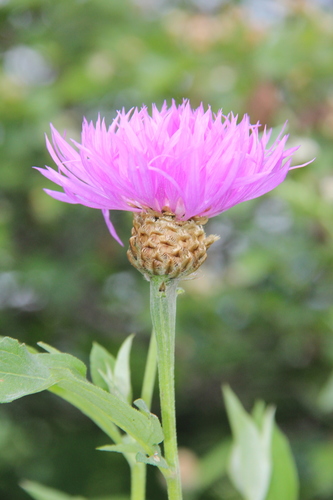
Psephellus dealbatus (Willd.) K.Koch has flowers that resemble the flowers of Centaurea americana in both color and form. Its composite inflorescence features rosy outer florets that shade to cream toward the center of the 2-inch disk. The inflorescence is surrounded by scaly bracts, and grows on a slender peduncle that ranges from 18 to 24 inches long. This species blooms in early summer. It is most notable for its leaves: like the leaves of Centaurea moschata, its leaves are divided, but unlike Centaurea moschata, the division of its leaves is quite regular. The undersides of its leaves are covered in silver hairs. Psephellus dealbatus is native to the north Caucasus, Transcaucasia, and Turkey, and has been introduced to Austria, the Baltic States, Belgium, Czechoslovakia, Germany, Great Britain, and Poland. It is widely cultivated as an ornamental plant, though it is not as well known as some other members of the Asteraceae family. It is widely adaptable and drought-tolerant. Its flowers attract butterflies and bees, and it self-seeds to some degree. The cultivar 'Steenbergii' is recognized, and multiple other cultivars are available. Sources that track weed species generally classify Psephellus dealbatus as a "casual alien", meaning it escapes from cultivation but is not invasive. It has naturalized in some areas of the United States.