About Psarocolius wagleri (G.R.Gray, 1845)
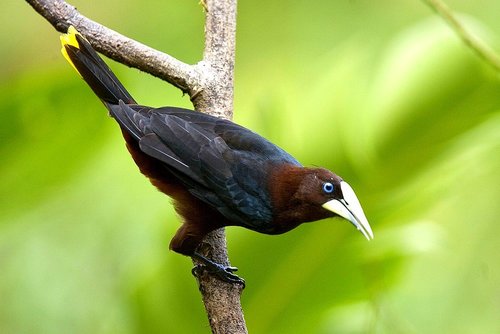
This species, Psarocolius wagleri, commonly called the chestnut-headed oropendola, has distinct size differences between males and females. Males measure 35 cm (14 in) in length and weigh 225 g (7.9 oz), while smaller females are 28 cm (11 in) long and weigh 125 g (4.4 oz). This species has very long wings. Adult males are primarily black, with a chestnut-colored head and rump, and a bright yellow tail that has just two dark central feathers. The adult male iris is blue, and its long bill is whitish. Females have similar patterning to males, but are smaller and duller in color. Young birds are duller than adults and have brown eyes. Populations south of the Honduras-Nicaragua border region are sometimes classified as the separate subspecies P. w. ridgwayi, but this classification is questioned. Males of this species have distinctive songs: a gurgle followed by a crashing guu-guu-PHRRRRTTT. Both sexes produce loud chek and chuk calls. This is a resident breeding species found in Caribbean coastal lowlands from southern Mexico to central Costa Rica, both slopes of southern Costa Rica and Panama, and Pacific lowlands of Colombia and northeastern Ecuador. While the species most often occurs below 1,000 m (3,300 ft) above sea level, it has been recorded up to 1,300 m (4,300 ft) ASL, for example in Colombia’s Serranía de las Quinchas. It may be more common at these higher elevations during certain times or in specific locations, but the altitudinal movements of this species are not well understood. The species is common across its large range, and the IUCN does not consider it threatened. The chestnut-headed oropendola lives in forest canopies, forest edges, and old plantations. It is fairly common in parts of its range, and can be seen in small flocks foraging in trees for large insects, fruit, and berries. It is a colonial breeder that constructs hanging woven nests made from fibres and vines, which measure 60–100 cm (24–39 in) in length and are built high in trees. A single colony may contain 40–50 females and only 4–5 males. Females lay two pale blue eggs with dark markings; eggs hatch after 17 days of incubation, and nestlings fledge 30 days after hatching. Botflies from the family Oestridae are the leading cause of nestling mortality, though brood parasitism by giant cowbirds (Molothrus oryzivorus) also occurs. Young giant cowbirds feed on the botfly larvae in these nests.