About Psarocolius viridis (Statius Muller, 1776)
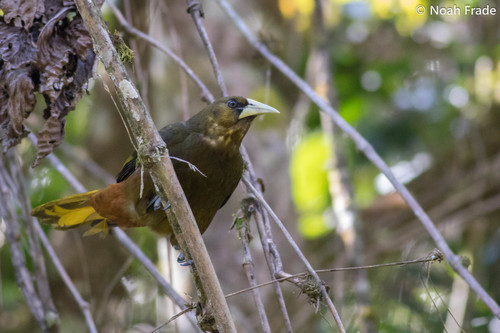
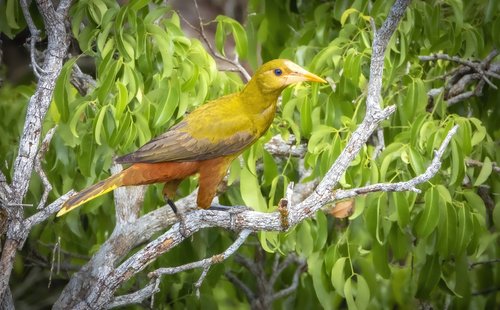
The male green oropendola grows to a length of about 43 cm (17 in), while the female reaches about 37 cm (14.6 in). Its head, breast, and back are pale olive green; the wings are greyish-green; and the rump and underparts are chestnut. The central tail feathers are black, and the outer tail feathers are yellow. The beak has an orange tip; its base and the adjacent skin areas are yellowish. The irises are pale blue, and there is an inconspicuous crest on the back of the head. Psarocolius viridis has a very wide distribution across the tropical rainforests of South America. Its range includes Colombia, Venezuela, Guyana, Suriname, French Guiana, Brazil, Ecuador, Bolivia, and Peru. This bird typically travels through the forest canopy in mixed-species flocks. It is an omnivore that forages for fruits and insects among leaves and branches. Because it consumes whole fruits, it acts as a seed disperser. It is one of several bird species that follow small groups of red-throated caracara (Ibycter americanus) through the canopy. Red-throated caracaras are specialist predators of wasp nests, and green oropendolas have been observed following these groups for several hours, feeding independently without needing to stay at the same canopy level or feed on the same food items. Green oropendolas are gregarious, colonial birds. They build long, bag-shaped nests that dangle from tree branches, and the species is polygamous. The nests of green oropendolas are sometimes parasitized by the giant cowbird (Molothrus oryzivorus), which lays its eggs in the oropendolas' nests.