About Psarocolius montezuma (Lesson, 1830)
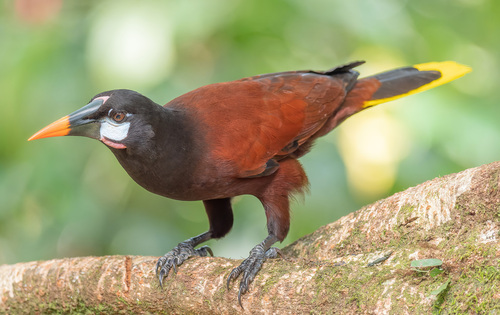
The Montezuma oropendola has the scientific name Psarocolius montezuma (Lesson, 1830), and no subspecies are currently recognized. Adult males are mainly chestnut, with a blackish head and rump, and a bright yellow tail that has just two dark central feathers. They have a bare blue cheek patch, a pink wattle, a brown iris, and a long bill that is black at the base and red at the tip. Females have similar coloration to males, but are smaller with a smaller wattle. Young birds are duller than adults, with a paler bill that lacks clear demarcation. This species shows extreme sexual size dimorphism: the male measures 50 cm (20 in) long and weighs 520 g (18 oz), while the smaller female measures 38 cm (15 in) long and weighs 230 g (8.1 oz). By total body mass, males are twice the size of females, for a 2:1 body mass ratio, making the Montezuma oropendola one of the most sexually dimorphic birds in the world. According to Webster et al., the size difference between males and females is likely directly tied to differing foraging habits: females typically forage on thin branches, feeding on insects inside curled leaves, while males typically perch on thick branches and forage in epiphytes and bromeliads. Webster et al. also found that sexual dimorphism is most pronounced in wing length and body mass. Male size and body mass are linked to sexual fitness and social dominance. Their observations of males defending sexually receptive females suggest that the Montezuma oropendola has a female-defence mating system. While females nest, males fight to drive off competing males, and males are ranked based on the outcome of these fights. An alpha male will eventually drive off all other rivals, leaving himself as the only breeding male present; when the alpha male leaves, other males return to defend females until the alpha male comes back. This mating system is more similar to that of polygynous mammals than most polygynous birds. The Montezuma oropendola is quite common in parts of its range. It is omnivorous, and is often seen foraging in trees in small or larger flocks, feeding on small vertebrates, large insects, nectar, and fruit, including bananas, Cecropia spikes, gumbo-limbo (Bursera simaruba) and Trophis racemosa (Moraceae). Outside of the breeding season, this species is quite mobile, and makes some seasonal movements. It lives in forest canopies, forest edges, and old plantations. It is a colonial breeder, and only females build hanging woven nests made from fibers and vines. Nests measure 60–180 cm (24–71 in) long, and are built in trees up to 30 meters high. Each colony has a single dominant male, which mates with most of the colony's females after performing an elaborate bowing display. The female lays two dark-spotted white or buff eggs, and incubates the eggs without assistance from the male; eggs hatch after 15 days of incubation, and young birds fledge 30 days after hatching. While nestlings are still in the nest, they are most often fed spiders, other arthropods, frogs, lizards, and fruits. Colonies typically hold about 30 nests, though colonies with as many as 172 nests have been recorded.