About Psarisomus dalhousiae (Jameson, 1835)
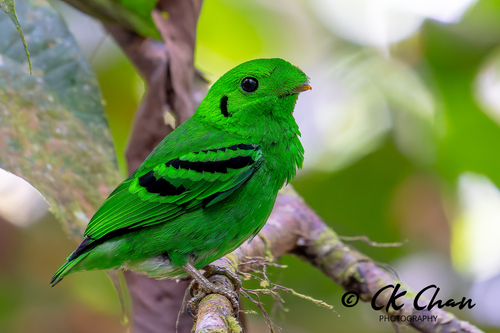
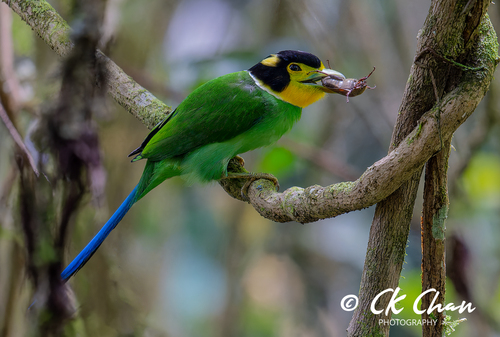
Description: Adult long-tailed broadbills have a bright yellow throat and face, with the yellow patch extending to each side of the occiput. The yellow feathers continue down to form a thin band around the neck. A thin layer of pale-yellow or whitish feathers surrounds the yellow patch below the throat. Some individuals even have a hint of pale yellow-green on the chin. They have a helmet-like black cap, with a sleek blue patch on the crown and a smaller blue patch at the back of the neck. The feathers along the back, belly, and top of the wings are bright green, a color produced by a combination of pigmentary and structural color. The underparts of the wings are a lighter green or blueish green. The primary feathers are black, with a metallic blue margin at the base of the external web and a white spot on the base of the inner web. Long-tailed broadbills have a long blue tail, but the under-tail is black. They have a strong, broad bill that is yellowish green in color with lighter edges. They have pea-green toes and brown legs. Juvenile long-tailed broadbills have a shorter tail, a green head, and duller plumage. A full-grown adult is about 25 cm (10 inches) in length, and weighs between 50 and 60 grams. Habitat and distribution: The long-tailed broadbill is found in the Himalayas and Myanmar, and occurs discontinuously through Southeast Asia and the Malay Peninsula to Sumatra and Borneo. It can be found across a range of countries: India, Nepal, Bhutan, Myanmar, Thailand, Cambodia, Laos, Vietnam, China, Malaysia, and Indonesia. It is most commonly found in broad-leaved evergreen forests, at altitudes ranging from 150 to 2500 meters. Its natural habitats include forests, streams and creeks, tropical and subtropical moist lowland forests, and tropical and subtropical moist mountain forests. It appears to prefer habitats near small bodies of water such as streams, freshwater areas, and wetlands. This is a resident, non-migratory species, though populations that live at higher altitudes in the Himalayas often move down to lower altitudes during cold winter months.