About Psammophis lineolatus (Brandt, 1838)
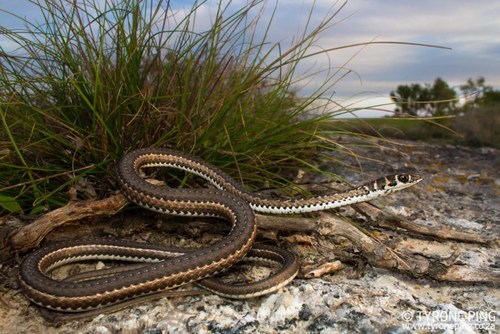
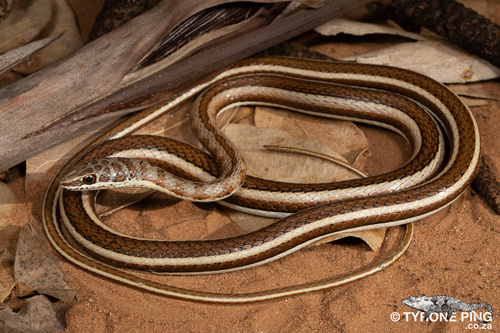
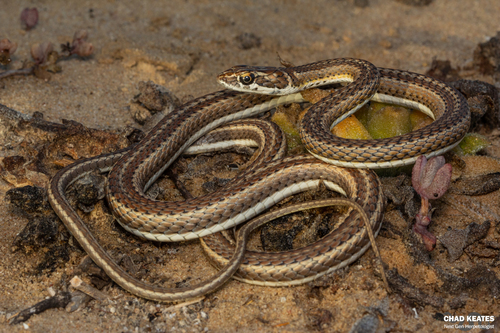
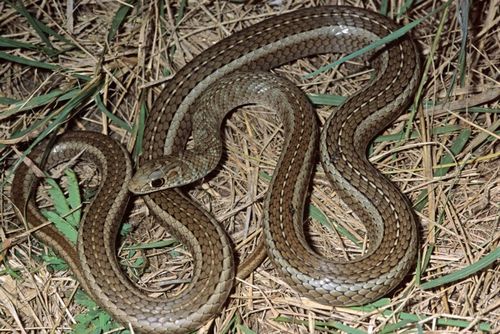
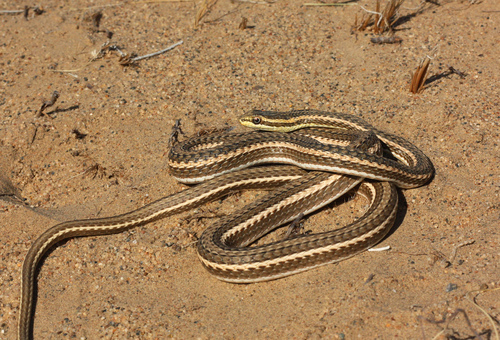
Psammophis lineolatus (Brandt, 1838) reaches a total body length of up to 91 cm. The front end of its muzzle is bluntly rounded, and its narrow head is only slightly distinct from the neck. The frontal shield is long and very narrow; the upper surface of the muzzle is concave, or features a longitudinal groove. The cheekbone shield is long and narrow. There are 17 smooth scales around the midsection of the body. This species has a large pupil, a divided anal flap, and a short tail. The dorsal body color is olive-gray, sandy, or brownish-gray; scale edges are slightly lighter than scale centers. Four dark longitudinal stripes with black edges run along the body; these stripes may sometimes be absent, narrow, or dotted, and they originate on the head shields. The belly is white, marked with grayish, brownish, or olive-gray spots that may merge into a continuous stripe running through the center of the body’s anterior third. This species, commonly called the arrow snake, is oviparous. Mating takes place in May and June. Females lay 3 to 11 strongly elongated eggs between late June and July; the eggs measure 30 to 55 mm long and 7.5 to 15 mm wide. Hatchlings, measuring 25 to 330 mm in body length, emerge in late July or August.