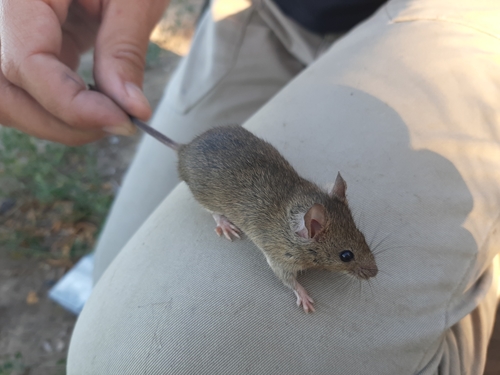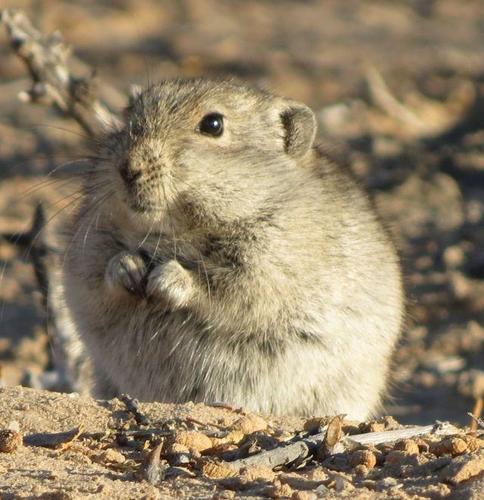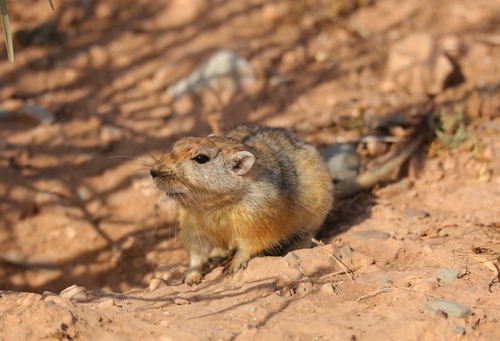
About Psammomys obesus Cretzschmar, 1828
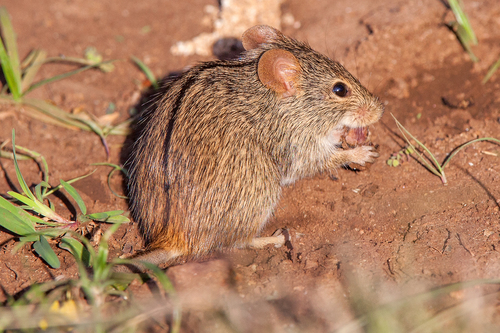
The fat sand rat (Psammomys obesus Cretzschmar, 1828) is a terrestrial mammal belonging to the gerbil subfamily, found mostly across North Africa and the Middle East, with a range extending from Mauritania to the Arabian Peninsula. This species typically inhabits sandy deserts, but may also occur in rocky terrain or saline marsh areas. Fat sand rats are highly diet-selective, feeding only on the stems and leaves of plants in the amaranth family (Amaranthaceae). When kept in captivity and fed the standard diet given to other rodents, fat sand rats can become obese and quickly develop diabetes-like symptoms. The average lifespan of P. obesus is 14 months in the wild, and 3 to 4 years in captivity. Fat sand rats dig burrows with multiple entrances directly beneath the plants they consume. They prioritize the local abundance of Amaranthaceae shrubs over other factors like cover when choosing burrowing sites. Because of this selection pattern, the species' preferred habitat and its distribution across a given landscape change each year in response to the growing seasons of the plants that grow in the wadi beds and terraces they inhabit. Wadi beds typically support Amaranthaceae shrubs and have dense vegetative cover, while terraces have very sparse vegetation and open, exposed habitat. The distribution of fat sand rats in a habitat is also shaped by local rainfall abundance and the previous season's population density at the site. In winter, fat sand rats prefer wadi habitats due to winter vegetative growth. However, after a wet autumn, more individuals will burrow in terrace habitats even when population density is low, which is not the case after a dry autumn: after a dry autumn, individuals only burrow in terrace habitats when population density is high. The burrowing activity of these rodents alters their habitat, impacting soil bacteria around burrows to decrease nitrogen fixation and denitrification activity. Burrowing also disturbs vegetation cover, further modifying the local environment. Mounds around active burrows have a significantly lower percentage of vegetation cover than mounds around abandoned burrows and undisturbed land near abandoned burrows. Fat sand rats breed from autumn to early spring, producing litters that usually hold between one and eight pups. Average litter size increases over the course of the breeding season. When females start lactating, their body energy stores increase, but toward the end of the lactation period they begin to use stored energy instead of increasing total body energy, which leads to a decrease in body mass. Pup growth rate is highest when litters are small and mothers eat plants with higher water content. Young fat sand rats disperse away from their mother at around 5 weeks of age. The sexual activity of male fat sand rats is not affected by weather conditions, but there is a correlation between rainfall and female sexual activity: more females are sexually active as rainfall increases. Males and females use different reproductive spatial strategies: females use smaller home ranges centered on their burrows that have enough food resources to support their young, while males occupy larger home ranges that overlap with the ranges of multiple females, giving them the opportunity to mate with several females. Females initiate copulation, performing a stereotyped set of behaviors when approaching males: they squeal, turn, dig, and kick sand toward the male. After this display, the female enters a lordosis posture, and the male mounts her over a series of copulations. Females often lose interest quickly, and will threaten or act aggressively toward the male between mounts. Fat sand rats stay lean when fed their natural plant-based diet, but easily become obese and develop type 2 diabetes mellitus when fed a standard grain-based rodent diet. Because of this tendency, they are used as an animal model for research into diabetes and obesity. Sequencing of the full nuclear genome of Psammomys obesus has shown that the Pdx1 homeobox gene, a transcriptional activator of insulin, has undergone extensive amino acid sequence changes in sand rats and other gerbil species. These changes are driven by the accumulation of GC-biased mutations, which are changes from A or T nucleotides to G or C nucleotides. Researchers have suggested these changes alter PDX1 protein function and may have contributed to adaptation to low caloric intake or to the species' diabetes-prone phenotype, but a direct causative link has not been proven. Many regions of the sand rat genome, not just the Pdx1 gene, have been affected by the accumulation of GC-biased mutations. Because fat sand rats are diurnal, they are also used as a model for human seasonal affective disorder. The species' presence in North Africa and the Middle East has healthcare relevance: molecular studies have detected Leishmania kDNA in fat sand rats, indicating the species can act as a host for the parasite that causes human leishmaniasis. Fat sand rats have been widely studied for their remarkably efficient kidneys, which allow them to produce highly concentrated urine. This ability enables them to eat halophyte plants and survive extreme heat and water scarcity in their desert habitat.