About Psammobates tentorius (Bell, 1828)
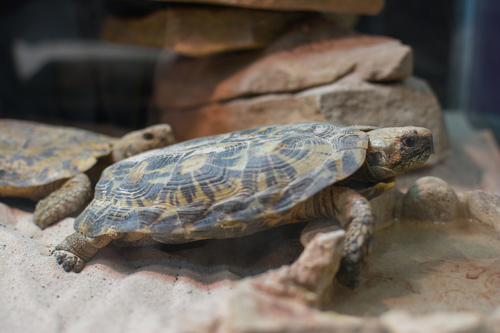
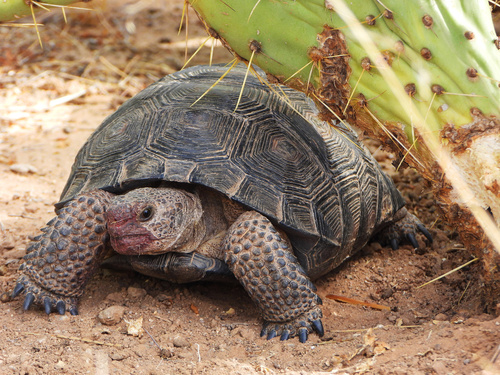
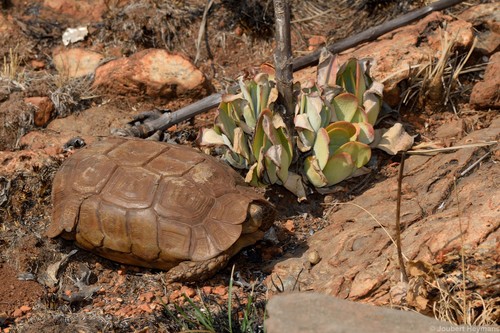
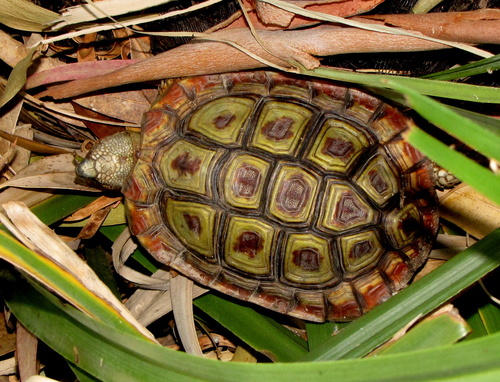
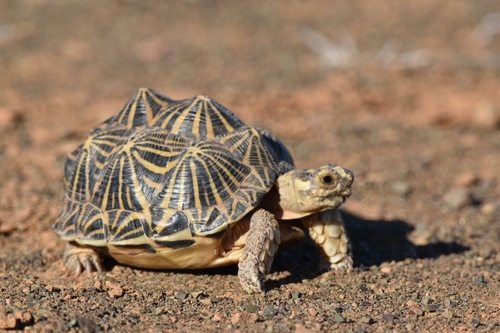
Identification: The Karoo tent tortoise (Psammobates tentorius) is a highly variable species with at least three subspecies. Its domed carapace is made up of individual shields, each with a star pattern of yellow or orange stripes radiating from its center, set against a dark brown or black shell background. The upper shell displays a distinct geometric pattern of shapes resembling "Bedouin tents", which fits the species since it is naturally adapted to live in semi-desert environments. Both the coloration and size of this small tortoise vary extensively, most notably between different regions, but also within single local populations. Uniform brown specimens occur occasionally, but this morph is very rare. Adult males are significantly smaller than adult females, and males have concave plastrons (belly shells). While this species shares many superficial external characteristics with other members of the genus Psammobates, it can be easily distinguished by its unserrated shell margins, and by the scutes along its shell bridge that are broader than they are tall. Distribution: The Karoo tent tortoise lives at very low population densities across the Karoo and other semi-desert regions of southern Africa. Its range extends from central Namibia to nearly the southern coast of South Africa. Throughout this distribution, the species' overall population is very sparse, and individual tortoises are typically rare and widely spaced. The species is growing increasingly rare due to habitat destruction and illegal collection for the pet trade. Because it has a specialized diet that relies on specific native Karoo plants, the Karoo tent tortoise very rarely survives in captivity, and usually dies quickly after being removed from its natural habitat.